Interviu: Fiorul vibrației creatoare în opera sculptorului Liviu Mocan

Sculptorul  clujean LIVIU MOCAN își are atelierul de lucru într-o zona linistită a metropolei universitare, parte de suflet a casei în care locuiește impreună cu familia sa.

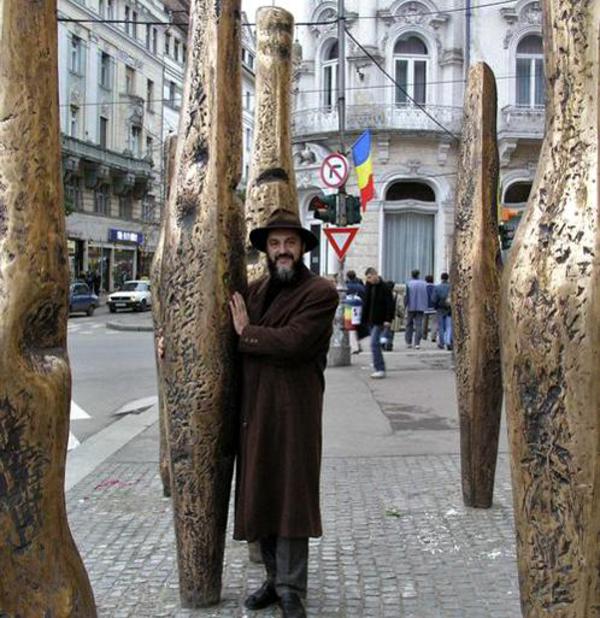
Casa – asezată mai departe de freamatul grosier si permanent al concitadinilor săi, departe de zgomotul inevitabil al unui oras prosper, fericit situată în liziera unei bucăți de pădure de rășinoase – are în fața ei, la stradă, curtea, împodobită cu “stâlpi împuscati” si “semințe”, fără de număr, lucrări care l-au făcut cunoscut pe sculptor în întreaga lume.

Intrând in atelier – pentru început – am făcut câteva poze cu sculptorul, asezat la birou, meditând, dar si în mijlocul lucrarilor sale dispuse, fie direct pe pardoseala, fie asezate pe rafturi, dupa nevoia lor de spatiu. Multe din ele pareau parca a astepta suflarea care sa le dea “viata” pentru a putea umbla în lume, cum ne va marturisi ulterior sculptorul.

In fata cestii de ceai, maestrul Liviu Mocan, a avut amabilitatea sa  raspunda intrebarilor de sondare a amintirilor si izvoarelor operelor sale.

Reporter: Ce îti amintesti, care au fost primele framântari care te-au dus în directia de a alege sculptura ca mod de abordare artistica si materializare a meditatiilor tale?

Liviu Mocan: Nu eu am ales arta pentru viata mea, ci arta m-a ales pe mine. Cu alte cuvinte, Dumnezeu mi-a dat acest dar, aceasta chemare. Nu a fost o ecuatie pe care eu am gândit-o : Nu eu am zis „voi face arta pentru Dumnezeu”, ci  nu puteam si nu pot altfel. Lucrul pe care stiu sa-l fac cel mai bine in viata, lucrul care ma bucura, e sculptura. Si vad ca ea are o mare eficienta si un bun impact pentru oamenii cu care intra in contact. Cu mesajele lor – care cuprind adevaruri fundamentale si cosmice – prin estetica, oamenii reactioneaza pozitiv si foate intens.
Au fost situatii în care vorbind unora despre o sculptura, oamenii sa plânga chiar, vazând mai departe de ceea ce se vede, stând de vorba cu ei, despre sculptura din fata noastra si mesajul ascuns, astfel, am ajuns sa simt, ca toata povestea asta care caracterizeaza viata mea, ca pe ceva ce nu eu am ales, ci ca pe ceva ce mi s-a dat inca din copilarie.
Imi amintesc foarte bine de vremea când eram copil, probabil prin clasa a II-a, si am facut un desen la scoala, si acum pot sa ti-l redau. Era un tânar schior care parca zbura cu schiurile, in orice caz se afla atârnat intre cer si pamânt. Iar pe la 13 ani când eram în clasa a VI-a, am realizat prima sculptura, o poti vedea aici pe raft. Este din alabastru. Cumva dintotdeauna am facut ceva in domeniul artei, din copilarie, fara sa mai pomenim mai apoi de scoala mica de arta – Liceul de arta, Studiile academice -Universitatea de Arta din Cluj si de cele post academice, din USA. In fapt, sculptura a constituit pentru mine cea mai puternica atractie a vietii, desigur, dupa relatia mea cu Dumnezeu si aceea cu familia.

Reporter: Dezvaluie-ne din munca ta de laborator, creativ, deoarece operele tale tradeaza autorul grav, un profund gânditor care le-a plamadit.

Liviu Mocan: Eu nu sculptez. Eu reverberez, eu vibrez. Pentru mine actul de creatie este o reverberare, un ecou al creatiei divine in mine, eu sunt in primul rând o sculptura si abia apoi un sculptor. Pe mine, aceasta sculptura, ma modeleaza Marele Sculptor, zi de zi, clipa de clipa, El face ceva in aceasta creatie care sunt sculptura Liviu Mocan. Apoi, ca ecou al acestor lucrari, pe care le face Sculptorul, cu majuscula – Marele Sculptor – in mine, eu reverberez. Astfel, am pus chiar intr-un poem aceasta realitate care tine de actul meu de creatie:

“Ecouri ale propriei mele daltuiri, imi sunt daltuirile,
Sarmane intruchipari, galbene, albe.
Eu nu sculptez, eu reverberez,
Soaptele iubirii se impiedeca si in mine, sarmanul.
Si daca astfel e dat, ce alta pot face sub soare,
A face mai bun decât marelui flutur si alb,
Cutie de rezonanta, eu sunt.”

Daca actul de creatie ar fi o expresie a lumii mele – asa cum cei mai multi ARTISTI incearca sa-si creeze o lume si ei sunt imparatii acelei lumi- profunzimea lucrarilor mele, ca fiinta umana, ar merge probabil maximum pâna la sexualitate, dar pentru ca eu nu vorbesc – sculptez – mai intâi, despre lumea mea, ci despre lumea Lui, nevazuta, careia eu insumi ii apartin, atunci lucruri extrem de profunde si extrem de grave, intra in reverberatia sufletului meu, lucruri care tin de adevar, de frumos, de bine, lucruri la scara cosmica, lucruri care depasesc cu mult capacitatea mea de percepere, si, astfel, arta pentru mine este acel loc in care eu ma integrez unei lumi superioare mie, pe care incerc s-o inteleg si sa intru in armoniile ei.

Reporter: Creatia divina joaca un rol primordial in opera ta, cum si vorbesti. Ce îti amintesti, care au fost primele tale framantari duhovnicesti în acest sens?

Liviu Mocan : Primele încercari pe care le-am facut în domeniul sculpturii au fost portretele celor dragi. Eram foarte tânar când am facut portretele bunicilor mei, din partea mamei, Oltean Petru si Oltean Ana, lucrare de foarte mari dimensiuni. Apoi, am realizat un portret a lui Viorel, fratele meu. Apoi, dupa ce Dumnezeu mi-a dat familie, am incercat sa-i portretizez pe ei, pe sotia mea si pe copiii mei.
De ce consider ca aceste lucrari raspund intrebarii tale? Pentru ca inteleg din ce in ce mai mult, cu cât imbatrânesc, ca relatiile sunt pietrele de temelie ale existentei umane : Relatia cu Dumnezeu si relatia cu semenii. Ca artist, foarte usor te izolezi in propriul tau turn, in turnul de fildes, si acolo intri in dialog cu piatra, cu lemnul, cu bronzul si stai de vorba cu materialele intâlnite si atât de frumoase ! Uiti de semenii tai, te izolezi si mori, intr-un sens. Pentru ca esti viu atât timp cât esti intr-o relatie. Universul nostru este un univers relational. De aceea cele doua porunci fundamentale, in care se aduna absolut tot, tin de conditia umana. Prima, iubeste-L pe Domnul Dumnezeu, si, a doua iubeste-i pe semeni. Si ce sunt acestea? Sunt relatii. Inca tot invat si acum sa ies din turnul meu si sa iubesc. Sa-mi iubesc sotia, sa-mi iubesc copiii, sa-mi iubesc vecinii, sa stau de vorba cu ei, sa am o relatie cu ei. Astfel, faptul ca le-am facut portretele celor din familie, consider ca este un act de spiritualitate, si anume una de esenta, pentru ca, altfel eu, prin natura mea, prin firea mea, nu as cauta aceste lucruri in mod natural.

Reporter: Ce anume iti inspira creatia ? Nichita Stanescu în poemul “Nod 28” spune ca “Daimonul meu vine de departe / in gazda fapturii mele, …” E o inspiratie de moment ce o determina?

Liviu Mocan: Aici, de fapt, prin ]ntrebarea aceasta, reintram ]n turnul de fildes, pentru ca aceasta supa, acest lichid, aceasta apa vie care favorizeaza actul de creatie, este relatia mea intima si personala cu Dumnezeul meu. Stau cu El într-o stare de vorba, intr-o incercare de a-L simti, de a-L intelege, de a-L trai. Si din aceasta stare curg ideile, curg motivele de inspiratie.

Reporter: Cercetând istoria operelor tale, vedem ca mai toate au mai multi ani pâna sunt finalizate. Ce anume face diferenta timpului scurs pâna la finalizarea unei lucrari?

Liviu Mocan: Dumnezeu este sculptor. Când Dumnezeu a creat din lut, din pamânt moale, fiinta umana, i-a dat forma exterioara, a creat sculptura din pamânt, dar nu s-a oprit aici. Pasul urmator a fost sa-i dea duh de viata.
Sculptorul marunt, cum sunt eu insumi si oricare dintre cei ai lumii si istoriei – în comparatie cu marele, totalul sculptor – facem insa la fel, cream obiectul de arta, dar el nu e gata pâna in momentul in care are suflet, pâna in momentul in care reusim creând ceva, o emotie, un reflex, o miscare, o patina, ceva care sa-i dea viata. Ceva, în alte cuvinte, care sa-i creeze emotia artistica. Sa nu privesti la obiectul acela, ca la un obiect utilitar, ca la un pahar, de pilda, pe care il iei, il umpli si-l folosesti, ci la un obiect de arta. Privitorului, când il vede, trebuie sa-i trezeasca o emotie. Atunci e gata o lucrare de arta când are suflet. De aceea, in atelierul meu sunt lucrari gata, unele de ani de zile, dar care nu sunt vii, nu au suflet si probabil vor ramâne nenascute, pentru totdeauna. Vor muri -ramân moarte- in atelierul meu si nu vor ajunge sa aibe viata, adica sa paraseasca atelierul si sa se mute si sa locuiasca intr-un muzeu, in casa cuiva, intr-un oras, pentru ca nu au viata.

Reporter: Care e relatia ta cu Dumnezeu în timpul elaborarii unei opere? Unde e El în acest timp? Cum vezi implicarea Sa?

Liviu Mocan: Eu nu sunt sculptor, eu sunt ucenic. Pe mine ma intereseaza extraordinar sculptura. Toata viata m-a interesat. Si studiez si observ si invat despre sculptura, continuu. Dar sculptura este regina piesei mele de sah, nu regele. Regele este Dumnezeu. Pentru mine arta este doar modalitatea in care ma apropii de rege. Este vehiculul meu, este fereastra mea prin care privesc universul, il privesc pe Dumnezeu. Incerc sa inteleg ceva despre lume, despre viata, despre mine insumi. Arta, este de la Dumnezeu, care mi-a daruit-o ca fereastra, un spatiu prin care El comunica cu mine. Când ajung la Atelier, primul lucru pe care incerc sa-l fac, nu este sa ma apuc de lucru, ci primul lucru este sa ma apuc de rugaciune, sa stau de vorba cu Maestrul meu. Sunt ucenicul in acel atelier, El e maestrul si rugându-ma il intreb: „Maestre, ce planuri ai Tu astazi de lucru, ce vrei sa realizam? Ce vrei sa facem?“ Imi deschid, inima, imi deschid urechea si incerc sa aud soapta Lui si in ziua respectiva ma ocup de lucruri care simt ca vin de la El, ca El vrea sa le realizeze.

Reporter: Cum se face ca operele tale tind mereu în sus, în înalt?

Liviu Mocan: Esenta evangheliei este verticalitatea. Opera de mântuire se realizeaza de Isus Cristos si prin imaginile lucrarii sale, de vizualizare, care sunt verticale, extrem de expresive. La ce ma refer? Mântuitorul Cristos a murit inaltat intre cer si pamânt. A murit vertical. Ar fi putut alege un alt tip de moarte, cum de altfel contemporanii lui au si incercat s-o faca, sa arunce cu pietre in El, astfel ca ar fi murit orizontal, dar Isus a murit vertical, legând pamântul de cer. Apoi, dupa ce a fost ingropat si a inviat din morti, S-a inaltat la cer, S-a inaltat, S-a inaltat pâna ce ucenici l-au pierdut din ochi, când ingerii au acoperit intrarea in celelalte dimnesiuni ale universului. Nu vi se pare interesant ca Mântuitorul, când a parasit lumea aceasta, S-a inaltat, adica a urcat la cer. El ne-a lasat pentru totdeauna o imagine vizuala a plecarii Lui d epe pamânt. Ne-a lasat verticala cosmica, axul lumii, invierea din morti. Aceste lucruri fundamentale cu privire la moartea si invierea Mântuitorului, inspira verticalitatea lucrarilor mele.

Reporter: Dupa cum stii,  am participat impreuna  la Conferinta CRESTEREA IN HAR – 25-28.10.2010, de la sala Romana a hotelului NAPOCA din Cluj, la care invitatul principal a fost scriitorul PHILIP YANCEY. Pentru acea sarbatoare ai pregatit doua lucrari foarte importante. Una ai « ridicat-o » ad-hóc impreuna cu un coleg si fiul tau (cred), in ritmul unei pisese de teatru foarte bine regizate. Sincere felicitari!  E vorba, mai intâi, de Piatra din capul unghiului, apoi, cealalta lucrarare, “Invitation/Decalogue” Vorbeste-ne, te rog, despre aceste lucrari.

Liviu Mocan: “Piatra din capul unghiului” – ca de altfel si “Invitatie/Decalog” – este o lucrare colectiva, este o realizare a vecinului si prietenului meu Daniel Veja, a fiului meu David Mocan si a mea. Am incercat sa exprimam impreuna faptul ca Domnul Isus Cristos este piatra de bolta a universului, piatra de bolta a mântuirii noastre. Pietrarii care construiau templul, au neglijat aceasta piatra fundamentala, neglijând-o adesea si azi. Daniel Veja este constructor. El intelege foarte bine cum pentru o bolta cât de importanta e piatra aceea care aduna si tine bolta, cheia boltii cum se mai cheama. Daca acea cheie nu exista, daca piatra aceea pe care se sprijina de fapt ambele jumatati ale boltii, daca piatra aceea nu exista tot esafodajul se prabuseste. Isus e fundamental. In piesa noastra, David, baiatul meu, copilul cret, frumos, inocent, in alte cuvinte, ingerul, lumea spirituala, care ne oferea aceasta piatra lui Daniel si mie ca si constructori in salopete care ridicam bolta, dar am refuzat-o mereu. Pentru ca nu-i vedeam locul ei, nici nu semana cu nici una dintre celelalte pietre. Deabia când am dat sa terminam bolta si am vazut ca ne lipseste o piatra, CAND a reaparut Ingerul cu ea, ne-am dat seama ca aceea este piatra necesara.

Invitatie/Decalog este o lucrare extrem de importanta pentru viata mea, este foarte importanta pentru conditia umana si este foarte importanta pentru generatia noastra. In contemporaneitate, civilizatia vestica, in mod special, a devenit relativista, considera ca nu mai exista absolutE. Ca absolutul il fixam noi fiecare dupa buna placere a carnii si firii noastre, a idealurilor, a dorintelor noastre. Pe când creatorul nostru, creatorul fiintelor umane ne-a daruit codul moral, ne-a daruit cele zece porunci. Si ni le-a daruit la modul in care ni se cuvine din partea lui, ca Imparat al unei imparatii in care noi suntem cetateni. El ne-a dat poruncile Lui si ne spune ce sa facem si ce sa nu facem, ce e voie si ce nu e voie. Dar toate acestea, desigur, ca sunt de folos pentru noi, nu pentru El. Astfel ca am creat aceasta lucrare, despre Cele 10 porunci, aici in estul Europei si Dumnezeu a destinat-o intr-un mod foarte, foarte interesant sa calatoreasca prin lume. Si, din estul Europei, acum un an, când lumea noastra protestanta sarbatorea 500 de ani de la nasterea lui Calvin, la Geneva (vezi si http://vimeo.com/9614663, vernisajul lucrarii expuse la Geneva), aceasta lucrare despre cele 10 porunci a fost parte a manifestarilor respective, din iulie 2009. Si a stat la Geneva mai multe luni, a iernat acolo, apoi Dumnezeu a dus-o prin alti frati lânga Los Angeles la Bellflower, de acolo a plecat mai departe in Michigan. Acum strajuieste – pentru un an – la Calvin College, National Liberal Arts College, in Grand Rapids, Michigan. Eu nu am planuit sa fac aceasta sculptura. Mie mi-a dat Dumnezeu ideea aceasta, acum 17 ani, si o aveam ca schita in atelier. Atât am putut eu face, atât mi s-a dat. Dar mai pe urma, Domnul a trimes diversi oameni, unul dupa altul, carora le-a dat alte obligatii si alte misiuni (unul a fost Jonathan Tame, misionar evanghelic englez, care a adunat bani s-o realizam la scara mare, cca 5 m inaltime fiecare componenta; apoi Adrian Gocan, Apoiray Verwise si foarte multi altii).
Aceasta sculptura este o metafora. O metafora care exprima mesajul sculpturii Invitatie Decalog, aceea ca cele 10 porunci sunt mâinile lui Dumnezeu care ne protejeaza sau ne pedepsesc, in functie de pozitionare noastra fata de El.

(mai multe informati despre acest grup statuar puteti gasi pe websitul acestuia http://www.liviumocan.com/ pe
www.invitationsculpture.com si pe pagina facebook invitation sculpture decalogue)

George Danciu

Isus te cauta acum

Motto. „Isus le-a mai zis: Adevarat, adevarat, va spun ca Eu sunt usa oilor. Toti cei ce au venit inainte de Mine, sunt hoti si talhari (…) Eu sunt Pastorul cel bun”- Ioan 10

Sa cercetam numai câteva locuri din Evanghelia dupa Ioan si sa observam unul sau doua tipare a modului in care Isus il cauta pe om.

(1) Isus te cauta când te afli unde nu doresti– Ioan 8.

„Dar dis-de-dimineata, a venit din nou in Templu; si tot norodul a venit la El. El a sezut jos, si-i invata. Atunci carturarii si Fariseii I-au adus o femeie prinsa in preacurvie. Au pus-o in mijlocul norodului, si au zis lui Isus: Invatatorule, femeia aceasta a fost prinsa chiar cand savarsea preacurvia. Moise, in Lege, ne-a poruncit sa ucidem cu pietre pe astfel de femei: Tu dar ce zici? Spuneau lucrul acesta ca sa-L ispiteasca si sa-L poata invinui. Dar Isus S-a plecat in jos, si scria cu degetul pe pamant. Fiindca ei nu incetau sa-L intrebe, El S-a ridicat in sus, si le-a zis: Cine dintre voi este fara pacat, sa arunce cel dintai cu piatra in ea. Apoi S-a plecat iarasi, si scria cu degetul pe pamant. Cand au auzit ei cuvintele acestea, s-au simtit mustrati de cugetul lor, si au iesit afara, unul cate unul, incepand de la cei mai batrani, pana la cei din urma. Si Isus a ramas singur cu femeia, care statea in mijloc. Atunci S-a ridicat in sus; si, cand n-a mai vazut pe nimeni decat pe femeie, Isus i-a zis: Femeie, unde sunt parasii tai? Nimeni nu te-a osandit? Nimeni, Doamne, I-a raspuns ea. Si Isus i-a zis: Nici Eu nu te osandesc. Du-te, si sa nu mai pacatuiesti. „

Observam ca femeia prinsa in preacurvie fusese adusa cu forta inaintea lui Isus. E drept, pentru a fi judecata, condamnata. Dar Isus schimba intreaga situatie. Acuzatorii pleaca drept pacatosi, iar femeia desi pacatoasa, aflata smerita inaintea Domnului, la judecata Sa adhoc, este iertata. “Nici Eu nu te osandesc. Du-te, si sa nu mai pacatuiesti. “

(2) Isus se lasa gasit când il cauti constient– Ioan 3.

“Intre Farisei era un om cu numele Nicodim, un fruntas al Iudeilor. Acesta a venit la Isus, noaptea, si I-a zis: Invatatorule, stim ca esti un Invatator, venit de la Dumnezeu; caci nimeni nu poate face semnele pe care le faci Tu, daca nu este Dumnezeu cu el. Drept raspuns, Isus i-a zis: Adevarat, adevarat iti spun ca, daca un om nu se naste din nou, nu poate vedea Imparatia lui Dumnezeu. “

(3) Isus se lasa gasit când il cauti inconstient– Ioan 4.

“Isus (…) se afla fântâna lui Iacov. Isus, ostenit de calatorie, sedea langa fântâna. Era cam pe la ceasul al saselea. A venit o femeie din Samaria sa scoata apa. Da-Mi sa beau, i-a zis Isus. Caci ucenicii Lui se dusesera in cetate sa cumpere de ale mâncarii. Femeia Samariteanca I-a zis: Cum Tu, Iudeu, ceri sa bei de la mine, femeie Samariteanca? Iudeii, in adevar, n-au legaturi cu Samaritenii. Drept raspuns, Isus i-a zis: Daca ai fi cunoscut tu darul lui Dumnezeu, si Cine este Cel ce-ti zice: Da-Mi sa beau! tu singura ai fi cerut sa bei, si El ti-ar fi dat apa vie. (…) Doamne, I-a zis femeia, da-mi aceasta apa, ca sa nu-mi mai fie sete, si sa nu mai vin pâna aici sa scot. (…) Dumnezeu este Duh; si cine se inchina Lui, trebuie sa I se inchine in duh si in adevar. Stiu, i-a zis femeia, ca are sa vina Mesia, (caruia I se zise Hristos); când va veni El, are sa ne spuna toate lucrurile. Isus i-a zis: Eu, cel care vorbesc cu tine, sunt Acela. (…) Multi Samariteni din cetatea aceea au crezut in Isus din pricina marturiei femeii… “

De curând am insotit un pastor la Inchisoarea de maxima siguranta din Gherla (Cluj). La intâlnirea cu pastorul, membru al fundatiei Stânca Veacurilor, in sala de Biblioteca (pe laturile incaperii strajuiau câte un rând de dulapuri vitrina, pline cu o multime de carti de beletristica), s-au prezentat pentru intâlnire, imi pare, 13 tineri insetati de partasie, cu invatatura sfintei Biblii si de prezenta Domnului Isus care promisese ca acolo unde sunt adunati doi sau trei in Numele Lui va fi si El prezent.
Aproape fiecare dintre ei avea Biblia si o cartea de cântari. Pregatisera si o cântarea noua, surpriza pentru noi, un imn de lauda pentru Domnul Nostru. Nevoia lor de Dumnezeu li s-a implinit când se aflau inchisi intre zidurile inchisorii, in mod cu totul neasteptat. Cine si-ar dori sa fie privat de libertate si stigmatizat de societate ? Dar, asa cum spunea liderul lor, conjunctural, erau liberi spiritual, eliberati de povara pacatelor, de necredinta in care traiau când erau afara!

Fiecare putem gasi gratia divina prin recunoasterea si asumarea starii de pacat, pe care s-o regretam din inima sincera, apoi a ne inchina inaintea Lui Dumnezeu, in Numele lui Isus si a ne pocai, a renunta a-L mai ofensa pe Dumnezeu. Doamne ajuta si da acest har multora!

SLAVA DOMNULUI ISUS CRISTOS!

The Final Judgment, from Myth to Reality!

Now you will gain a new perspective regarding  The Final Judgment

Interview conducted by Mircea Alb – 1997

Lia Rusu

Graphics and Romanian text editing – Mircea Alb – 2010
E-mail : a.mircea@yahoo.com
Translated from Romanian
Copyright © 2010. All rights reserved.

Introduction

My name is Lia Rusu and I was born in 1947 in Oradea, Romania. I am a professional artist and former visual arts instructor at the College of Fine Arts, University of Oradea. The following testimony describes an unusual experience that I had in the summer of 1993 regarding the Final Judgment mentioned in the Bible.

The Beginning of the Experience

I became a Christian around the age of 24. Early in my faith, while reading the Bible, I became very impressed by the passages that mentioned that we will be held accountable for how we live our lives. Specifically, after death, each individual will come face to face with God in order to be judged according to all of their deeds and actions while living on Earth.
I began wondering, how was it possible for God to know even the most insignificant details of our lives on Earth? And how could God record everything? Even though I was eager to know and learn more about this subject, I knew it would be difficult to understand it thoroughly, yet I was equally curious to find out how the final judgment from the Bible would take place.

The Angel’s Visit in My Room

I did not understand all these matters at that time, but eventually I stopped being preoccupied by this particular subject. Time had passed, and after many years, at a time when I was no longer thinking about it, I received a visit. During the summer of 1993, in one of the early mornings between 4 AM and 5 AM, I was suddenly awakened. I sensed that somebody had entered into my room, and when I looked closely at that person, I instantly understood that it was an angel. His presence did not make me feel uncomfortable, nor did it create a state of fear in me. The angel approached my bed and talked to me in a soft and resolute manner:
Lia, you have wished to see what the final judgment would be like and I have been sent to take you to see it, but for this to happen you must first die.
When the angel told me that I would have to die in order to be able to see what the final judgment would be like, I worriedly replied that I did not want to die because I had small children that needed me. Then the angel replied,
Just believe, because with God all things are possible.
Journalist – So, did you see someone enter your room?
Lia – Yes, I did see an angel.
Journalist – What did this angel look like? Could you describe the angel in more detail?
Lia – Certainly. The angel looked like a person, but he was taller than a human. He was very luminous and his body was entirely dressed in a coat of light. Very simply put, in his presence I felt immensely confident and totally safe.  That is why I was not afraid at all when I saw him in my room.
Journalist – What was the apparent age of that angel?
Lia – The angel looked like a young man, of age between 25 and 30 years old.

The Travel into Space

After the angel told me that all things are possible with God, he continued,
Come after me, but step only where I step, and do not turn to the side.
When the angel spoke and asked me to follow him, I was compelled to do so at that moment. Throughout my entire experience, I was unable to refuse anything he asked me to do.
Therefore, when the angel asked me to follow him, I felt that I was rising to my feet off the bed and that I had to go after him. We moved very quickly, riding on white horses for part of our  journey. At a certain moment, we stopped and dismounted in front of a very wide river. I knew that we had to cross, but there was no bridge anywhere to be seen. Then the angel told me again,
Step only onto the shape of my footprints and follow me!
He moved ahead and walked on water as easily as he would have walked on ground, and I followed right behind him stepping precisely onto the shape of his footprints as he had instructed.
To my amazement, I could feel that the water was hardening and becoming as dense as stone wherever I would step. We walked on water as if we had been walking on solid rock. We crossed that wide river very easily, without my feet getting wet at all. When we arrived on the other bank of the river, I noticed that my body had gone through a transformation. I immediately realized that my body was no longer composed of matter (flesh and blood) and it no longer had weight.
I now possessed an extremely light body, and found that it could penetrate effortlessly through everything. Moreover, I came to have an extra sense that I did not have before. I was able to understand absolutely anything and everything that was happening to me and around me. I was able to communicate with the angel without using my voice, through direct thoughts exchanged between us. I was effortlessly asking him something in my mind and he was answering the same way.

The Visit to Hades*

* N.T. – Hades (a Greek word) is the translation of “Sheol” (a Hebrew word, from the Hebrew Scriptures). It refers to the temporary abode of the dead (Revelation 20:13, Acts 2:31, etc.) who are awaiting their resurrection. It is separate and distinct from the final “Hell” (a translation of Greek word Geenna “??????”, equivalent to the Hebrew Ge Hinnom, or English “Gehenna”, the eternal Lake of Fire, – Revelation 20:14-15) which is the place of eternal punishment for the damned. (For more details, see any New Bible Dictionary).

Right away we started to descend together through the ground. From the very beginning I knew the angel would take me to Hades because he had previously told me,
Now we shall travel the distance that separates us from Hades.
We were able to pass through Earth’s matter without any difficulty. Suddenly, the foundation of the Earth appeared in front of us. I was deeply impressed by its great appearance and grandeur. I stopped for a few moments to admire it. It was so beautiful! As I stood in front of it, I immediately understood that God had settled the Earth on a foundation.
Journalist – In what shape or form did you see or perceive this foundation?
Lia – Even though in school we were not taught that the Earth has or is settled on a foundation, when I was in front of it that’s exactly what I saw. This foundation had the shape of huge pillars, extremely solid, that seemed to be fashioned from a kind of white, shiny marble. In fact, it is very difficult to me to describe the beauty of that foundation, not to mention everything else that I saw there. It appeared to be an enormous construction, very majestic, and firmly anchored in the Universe. Stopping to admire that beautiful piece of God-made architecture, the angel warned me that we needed to continue our journey and move farther on toward Hades.
As we continued beyond the foundation of the Earth and were travelling, I came to see some gigantic gates in the distance. I instantly understood that these were the gates of Hades. As we drew closer and closer to the gates, I began to feel a profound pain and a heavy spiritual weight within me. My suffering was becoming more pronounced and harder to bear with every step. Then, I started to moan like someone who is going through intense pain or suffering. I asked the angel why I was feeling pain as we were approaching the gates of Hades. The angel answered,
You feel exactly what a soul feels who comes here from Earth after his physical death and who must enter Hades. Therefore, you experience the same feelings.
As we continued our approach and were getting closer and closer to the gates, the spiritual pain and weight within me became almost unbearable. Many of you may have experienced great trials in life, troubles and despair, hopeless situations when you could find no encouragement or consolation from anyone or anywhere. That is how I felt then. I felt that once I entered through those gates, any hope of ever getting out of that place was lost.
After I entered Hades, I lost any previous desire to see any family there, or to find answers to questions like “Where were they?”, “What were they doing?” or “How they were doing?”
The moment I entered, I realized that all the souls in that place had a body identical to mine, with the same properties. Everyone was perfectly conscious and understood absolutely everything that was happening around them. Everybody knew where they were and why they were in that place.  All of whom I was passing by knew who I was, and I knew who they were.
Journalist – Did that spiritual body we are discussing have a shape?
Lia – Yes, it had the shape of the human body with the only difference being that it was not made from flesh and blood.
Journalist – Did it have a face or facial features?
Lia – Yes, certainly.  There the spiritual body had the same facial structure and appearance as that of the respective human while living on Earth, but it was, let’s say, rejuvenated. For instance I knew that a man who stood in front of me was in fact my former neighbor from across the street who had died some time before. I knew it was him and I even felt his pain because he was in that place. He also knew who I was. There, absolutely everything is known.
Journalist – Even though, let us say, that man died at 60, was his face looking like it was in his youth?
Lia – Yes, every one had the same facial appearance that he or she had while living on Earth, but evidently rejuvenated. There, even though I may not have known any particular person before, when I was in front of anyone, I instantly knew everything about that person.  I knew things such as: what kind of people or nation that person had belonged to, what had been their cause of death, even if the death might have occurred 2000 years ago. All that information was instantly available to me! I also knew that all the souls that were present there were waiting for the Final Judgment.
Then it was given to me to understand and feel the pain, spiritual burden and despair of those souls that were in that place. Furthermore, I knew that once one entered into that place, hope was lost of ever being able to get out again.
Hades is the very first great separation from God, and all the souls found there were fully conscious that once in that place, they could no longer reconnect to God in any way. They knew they would be summoned to face God at the final judgment for their deeds while living on Earth. They also knew they could not correct anything from their past. Once they had died and had been brought to that place, any hope of mediation or help from God was then gone forever.
That was the reason all those souls were living in a state of terrible agony and sorrow, of insecurity and uncertainty because they did not know the verdict they would receive at the Final Judgment. Would they be forgiven for the mistakes they made during their lives, and thus, be saved from that place? Would they be found guilty and be sent to Hell forever? Each of them was very familiar with the facts of their own life and was fully aware – more than ever – of the significance and gravity of sins. Each had a chance to turn onto the right path during their Earthly lives but they had disregarded it. Tortured and torn apart by all those thoughts, everyone was frantically analyzing the facts of their lives, trying to find something, anything that might come in their favor or could soften their circumstances at the Final Judgment. Therefore, each soul was intensely preoccupied by their own situation, no longer caring for anyone else around them.
Overwhelmed by the torturing atmosphere of that terrible place, I did not want to go any further or see anything else that existed there, as I had initially wanted when the journey began. I was intensely overcome with the deep sorrow and awful pain of being forever separated from God.
The separation from God that one feels in Hades cannot be compared to any pain felt on Earth! I wish that no single soul on Earth would ever end up in Hades. Words cannot describe what is felt when you are separated from God in that place.

The Journey onto the Mountain of God

Being afraid of staying there longer or to be forgotten by the angel in that place – where once arrived you cannot exit – I started to cry and groan like a child. Noticing the state I was in, the angel escorted me out from Hades and told me,
Now we are going to go farther and climb onto the Mountain of God.
As we departed from that terrible place, the pain and burden I was feeling started to fade away. Ahead of us laid a completely different perspective. The distances of the Universe are enormous, but we managed to move with an astonishing speed.
It seemed to me that only a few moments had passed and we already arrived at the foot of the Mountain of God. Suddenly I found myself in front of a very high and imposing mountain.  Then I understood that the mountain was the Mountain of God and we would have to climb that mountain the same way one would hike on a mountain on Earth. Everything was in an unimaginable display of splendor and holiness, almost impossible to be described in words.

The White Path

While looking at the mountain, I noticed that, starting from its base, there was an extremely white path, as wide as a human palm, unfolding up the entire mountain toward its summit. I had never seen such an intense white on Earth. Any footstep, had it been stained, would leave a trace on that path. It depended on whether your feet were dirty or not, if your life was clean or not.
The angel warned me not to step aside from the path because the mount is holy and if I hesitated from the path I would fall down from the mountain. Why was this so?  Because I would need to be able to understand certain aspects and scenes that I was about to see.
All those who were ascending on that path were dressed in white clothes. I understood they represent people still alive on Earth. At a certain moment, during the ascension, I noticed that some were walking more easily and some were having difficulty in their walk. Some were crawling on their elbows and knees and hence had many wounds. The angel explained to me that some were ascending much harder than others because they had endured humiliation and sufferings on Earth due to their faith in Jesus Christ, and some paid even with their own lives.
I saw an old little man that was climbing with very much difficulty; he was wounded all around his elbows. When I saw him, I instantly acknowledged everything about him – where he had been from, what church he had belonged to, and so on. Being anxious to find out the explanation, I asked the angel,
Why is that old man having such a hard time moving forward on the path?
The angel explained,
He is persecuted every day because of his faith in Jesus Christ, but he stands strong in his faith.
I noticed the difficulty with which this old man was climbing on the path. He was earnestly advancing despite of his sufferings and was ready to even give up his life for Jesus Christ.
As we were moving ahead onto the path, I saw that some were stepping outside of it. They were not able to return onto the path because in the meantime it was occupied by those who were going up. Therefore, instead of going up, these backsliders were going back down. Moreover, some of them were not able to simply walk down, but they were tumbling toward the base of the mountain. Then I asked the angel,
Who are those that are descending? Stop them, please, do not let them go down!
The angel replied,
I cannot stop them, I am not allowed to. I do strictly what I am told to do. If I am told to do something, I do it, or if I am told not to do something, then I do not do it.  I have no right to stop anyone. Everyone is free to do whatever they want with their life.  Each individual is free to decide either to climb the path of their life to God until the end, or turn away from the path, abandoning it, if they choose to do so.
Then I asked the angel,
What will happen to the souls of those that are descending?
And the angel answered,
They are now going where we have come from – Hades.
Being worried for the fate of those souls and knowing what their ending would be in that place, I insisted on asking the angel again,
Oh, but stop them, do not let them reach Hades!
The angel told me again,
I cannot do that. I only do what I am allowed to do. These souls go there because they no longer like the path that leads to God, but they will be held accountable for their decision.
Journalist – Who do you think these descending souls were? Coming back to our life on Earth, who might represent these souls?  They must have an equivalent in our world, right?
Lia – Yes, that is correct. Those souls as I understood represent the people still alive on Earth that had decided at a particular moment in life to come to Jesus Christ as their Lord and Savior, adhering to His word.  They loved and revered Him for a while, but then they started disliking the pure life they were supposed to live, as Jesus asked them to live. Therefore some of them said to themselves,
“This path is too hard and too narrow for me. In fact I cannot do whatever I please, I cannot have a lover or an affair if I want, I cannot get rich and do dirty business, I cannot do this and that.”  These people no longer wanted to go with Jesus because Jesus Christ Himself is the path, the white path onto the Mountain of God. On that path one can only step with extreme care because any spot, no matter how faint it might be, is still visible and any soul will consequently be scrutinized for all the unclean spots and traces left behind on the path.
Those souls were going back to the life they had before coming to Christ, they were going back to the sinful lifestyle from their past. They were doing this consciously and not determined by anyone else. They began to dislike living a clean life. They abandoned their faith in God and His salvation and went back to their previous worldly sinful lifestyle.
They traded their salvation for worldly pleasures. This may seem very pleasurable at the time, and some may think this exchange will bring prosperity and freedom, but one cannot see how they reached this prosperity, whether or not there is an extramarital affair or some other sin behind their apparent success. These people may say: “Why not? It is not such a big sin.” According to their logic, nobody sees it, nobody knows about it. This type of reasoning leads to actions that are profitable or pleasurable for a short time for some, but in the end they will be asked to give an account for their deeds. Their judgment will be much more severe because they had heard the truth but chose to ignore it.
As I stood on the Mountain of God, I suddenly saw an immense fire on the top of the mountain. That fire was so great and imposing that you could not take your eyes off it. That fire was continually and relentlessly burning! It had a common base for three immense and distinct flames. When I looked at it, I instantly understood that this was God – the Father, the Son, and the Holy Spirit. It was the Divine Himself within the fire on top of the mountain!

In the Final Judgment Courtroom

After that we immediately turned to the left and the path suddenly changed direction. An enormous hall appeared in front of us. It was the courtroom where the final judgment would be held. Its dimensions were immense and seemed to be of cosmic magnitude. What was interesting about these heavenly dimensions was that the greater they were, the closer they appeared to be.
When we arrived at the doorsteps of this hall, above it there was the same immense three-flame fire that I had previously seen on the top of the Mountain of God. There I also saw a huge bright cloud, which I understood right away that it was formed of all the saints that had lived on Earth and had been subjected to the First Resurrection, which I had not witnessed.
Then the angel placed me exactly on the doorstep of the judgment courtroom. In front of me stood this huge courtroom, and deeper into the courtroom there was a very large and long table. At each of the two ends of the table there was an angel, both of which looked like the one that was escorting me. The two angels were assisting a third person that was sitting at the middle of the table. I immediately understood that the third person was the Lord Jesus Christ. On the sides of the courtroom were very many immense shelves having a multitude of books on them.
These books were in fact the book of life of each individual that ever lived on Earth, containing a record of their entire life with all their actions and deeds.
Suddenly, a very loud noise was heard, a roaring sound produced by large crowds of people in motion. This marked the resurrection and the beginning of the judgment of those in Hades!
They were marching toward the final judgment courtroom, coming aligned in huge columns. They had been resurrected by generations, starting with the first generation that inhabited Earth and ending with the last generation. Among them were teenagers, men and women, young and old, belonging to all the nations of the world. They were coming in huge waves, one wave after another, like the waves of an ocean. It was a terrifying and trembling noise that seemed to shake the whole Universe. One angel was sitting to the right and another to the left and they were arranging those coming in into two rows by the time they were entering the hall. Everything was being conducted and executed in a perfectly ordered fashion.
After the resurrection of the dead ended, a total silence settled in. The entire audience was waiting for the judgment to begin.

The Judgment of a Man

I personally witnessed the judgment of one man.  He was brought in front of Jesus by one of the usher angels. Then one of the two angels sitting at the table extracted that man’s life book from a shelf in the library and placed it on the table, in front of the Lord Jesus.
The next moment a screen of gigantic dimensions appeared in front of all of us, similar to a cinema screen. The kind of technology that I have witnessed over there is not known on Earth: when the Lord opened the book of life of that man, starting with the first page, the entire life of that man started rolling on the screen in front of us and in front of the whole Universe. The Lord Jesus was not in a hurry and while He was patiently turning each page of the book, images and sound showed everything that man had done during his life.
Everything could be seen to the finest detail, moment by moment, day by day, starting from birth, through childhood, youth, and adulthood up until death. At the Final Judgment, everything that man had done, whether good or evil, every thought, word and feeling from his entire lifetime was shown exactly like a film in front of us all. Nothing remained hidden! Everyone could see and hear even the most intimate thoughts and feelings that man had during his life, including the most discreet, known only to him, all of them resonated and were speaking loudly and clearly to all of us.
At this judgment, the Lord Jesus was the only judge.  Nobody intervened, not even the Father who was overseeing from the summit of the mountain. Jesus Christ was the only one that decided and gave the final verdict, after analyzing the whole life of the one who was on trial.  The analysis and judgment were made in front of everyone, so that all could see clearly that His judgment was righteous.
And thus we found that this man was a priest in a church while living on Earth, and hence the truth had been relatively available to him. After watching the life of that priest in fine detail, I felt full of shame. I fell down on my knees right there on the doorsteps of the courtroom. I bowed my head to the ground, feeling I was a tiny particle of dust in the presence of Lord Jesus.
After witnessing all those events, I became more conscious than ever and fully convinced that all we do on Earth is recorded and nothing can be hidden nor concealed from the face of God. In those moments I began thinking about my life and I boldly, but fearfully, said to myself, “Lord, only Your mercy and clemency can pardon us from Your righteous judgment!”
After that man’s entire life had rolled in front of everybody, the Lord asked him,
Do you have anything to say in your own defense?
The man bowed down his head in front of the Lord and was silent. He could say nothing in his defense, because he knew that nothing he did had remained hidden.
In those moments I understood – and this fact shocked me profoundly – that whenever necessary, the Lord could ask any of the saints from that shiny cloud above the courtroom to stand as witnesses for any relevant moment from that man’s life. Some of them had lived in close proximity of the judged person and could have confirmed any aspect or detail related to that man’s life.  Moreover, it did not matter what kind of religion the man had embraced during his life on Earth. The judgment was made according to the amount of knowledge and how much was fulfilled in accordance with the Ten Commandments from the Bible.
Furthermore, the Lord Jesus could also summon non-living things as witnesses, things that were around the person at certain times, such as the closet from his room, the crossbeam of his house roof, the road the man had walked on, the tree he had passed by every day or anything else. These objects could appear as living beings before the Lord, and testify, confirm or deny facts, events and details regarding that person. This is the majesty of the Lord Jesus. When I saw and understood all these things, I was in complete shock and tremble because I never would have thought that something like this is possible.

The Verdict and the Sentencing

In the moments that followed, a dense silence enveloped that judgment hall. All of us were waiting for the final verdict with great anxiety and tension. This man’s eternal destiny was being decided, and he would either, be forgiven and accepted into Heaven or he would be condemned and sent to Hell forever. The judgment of that man continued. Lord Jesus opened another book that was on the table, which I understood that it was the Book of Life. The Lord searched and found the man’s name written in it.  Then, the Lord addressed the man,
Because of the words you have told others about Me, that I am Life, that I am eternal Life, and that knowing Me by hearing My Word and choosing to follow Me means gaining eternal life, I pronounce you blessed, because others around you have benefitted from the words you have spoken.
The next moment, all those that were present including the angels, saints and all other celestial beings erupted in a loud cry of joy because one soul had been pardoned. The Lord Jesus then signaled to the Sun to come closer. The Sun, with all its great beauty, came in the form of a living being, bowing to the ground as it stood before the Lord. Then Lord Jesus addressed the Sun, saying,
Take off your garment, and go and dress him with it!
The Sun, just as a human would have done, took off his garment, and dressed the man who now received the shine and splendor of the Sun. Then the man was taken to join the group that was glowing just like him. Then I saw that there were different groups of individuals that had different intensities of brightness. There were some groups that shined so intensely that their brightness was almost merging with the images of their spiritual bodies.

The Return to Earth

This was all I was allowed to see from the Final Judgment, which continued. The angel took me out of the courtroom and told me,
We are returning to Earth now.
It was time for me to leave that wonderful place where for a brief period of time I was allowed to stay and witness these events. This time, my soul was in a completely different state compared to the initial one. At the beginning of the journey I had told the angel that I did not want to die just to be able to see the Final Judgment. Now I was so overwhelmed by everything I had seen, heard and felt on this journey, that I did not wish to return to Earth.
The contrast between the two worlds – the celestial and the earthly – seemed so huge to me, that I came to ask myself in wonder, “Why do we humans love our lives on Earth so much, lives that are so often imperfect, dirty, full of suffering and above all, lacking in the splendor of the presence of God?”
It was very difficult for me to accept the fact that I had to go back to Earth where I would have to live in my physical body again. I knew that it would be impossible not to make mistakes for as long as I would be in that material body. I asked the angel not to take me back to Earth but to leave me there, where I felt I was truly at home. Instead the angel wanted to remind me of something very important upon my departure and replied,
Those you saw descending onto the white path from the Mountain of God are those that had trampled the grace that had been offered to them. You all have a great, great gift! You have the grace! You are offered the Salvation freely, and you are forgiven by the grace made available through the death of the Lord Jesus Christ who died for you all. The dirty garment of your soul was cleansed when you came to Him and through His blood you became clean. But whosoever tramples this Grace must come to the Judgment.
I then understood that it is easier for those who have known or have had a connection with a certain degree of truth, but did not have the chance to know the grace and receive it. Perhaps there are people of different faiths, Buddhists, Muslims and others who have a high moral standard, but did not have the chance to know about this grace. Their judgment will be lighter.
However for those who heard about this grace but despised it, in other words those who were offered this priceless gift and rejected it, will be condemned and lost for eternity. I do not wish that anyone would end up at the Final Judgment for something like this, in front of the Lord Jesus Christ.

The Aftermath of the Journey to Heaven

Knowing that I would have to come back home, a strong feeling of shame encompassed me. I did not want to go back and live on Earth again. I was aware that I had a family, but I also knew that Lord Jesus could help them move on without me. Finally, I had to accept that I needed to return to Earth. I left the Mount of God and the Judgment Hall and I returned to the same place from where I had departed. I found myself in my room again, back in my physical body. In the next coming weeks, I felt extremely sick and very weak. I was so profoundly marked by this experience that I simply felt I did not want to live any longer.
Journalist – Are you referring to the fact that you were sick physically or spiritually?
Lia – I meant it both spiritually and physically because I started to suffer in my body. Everything around me now appeared to be ugly and dirty! I was seeing myself as being ugly as well. I was disgusted by my own person and by everything that surrounded me. It all seemed ugly in contrast to what I had seen during my visit to that marvelous realm of God. I did not want to eat anymore and I sensed that my body was rejecting the food, as well as refusing to live any longer.
Journalist – Why?
Lia – It became difficult to live on Earth because I was conscious that while I lived in my physical body it was impossible not to fall short of God’s commandments and not to sin. Right after the return to Earth, I became aware like never before, of what sin really means and what its consequences really are. At the same time I was overwhelmed by the Lord’s greatness and by what I had witnessed where I had been. I was overwhelmed by His righteousness and by the holiness I had seen there. If it were not for the freely available grace of God, we would be the most lamentable beings standing before the Lord Jesus Christ.
I had seen and felt the holiness of the Lord Jesus, of His divinity and that of His Mountain, which could not be walked on with disregard. Those who embraced the sin in their lives were forced to descend, being unable to continue climbing while clinging to their sin.  Everything was beaming with holiness in that place. The angel had added,
This holiness is granted to you by grace, through forgiveness!
Because Jesus Christ had paid the price for our sins which were washed away through His blood, we received a gift, a priceless grace, Salvation. Salvation is worth more than any treasure on the face of the Earth, it is worth more than all the billions of dollars the richest man in the world might ever have.
The most sorrowful man in eternity is the one that will not be saved, that would not know the Lord Jesus Christ and that would not change his life the way He asks everyone to!
I lost my desire to live because I loathed all things around me: wealth, food, and anything else that could separate me from the Lord Jesus Christ and His salvation. I felt that living means either being totally committed to Jesus or to live with disregard towards God’s grace, trampling it with a despising attitude, way of thinking and emotions. I was shown how absolutely everything would be revealed at the judgment, every feeling, thought, look and deed. However it was of great comfort and relief for me when the angel said,
You all benefit from a great gift, the grace.  Anywhere you will travel on Earth, tell others what you have seen and how this grace surpasses everything. To be and to live by grace with the Lord Jesus, is everything. Salvation is everything!
If there was ever a time when you loved someone with all your heart and soul and at that moment you felt you could not live without that person, that feeling is like a moment of eternal bliss. Much more than that, anyone can live eternally within such complete love without lacking anything.

Conclusions

Then I told myself that I must share the message of hope with any person that I will meet, that Jesus Christ is our Savior.
Journalist – Finally, what would you like to communicate to those that will read this testimony?
Lia – I would like each individual to believe, and mostly to be convinced that beyond the reality of everyday life on Earth and beyond our physical death, there is another world just as real as this one, but nonetheless completely different. Our journey does not end at the grave, but we continue into another dimension, whether we believe it or not. We go further, our final destination being either Heaven or Hell. There isn’t a third choice. As long as we live on Earth, each of us is free to choose our final destination. If we want Heaven to be our final destination, then we have to come to Christ through faith, yield to Him as our Master and Savior, and consequently live our life by His commandments.
Moreover, I would like everyone to know and be convinced that there will be a final judgment, and we all will stand before God and be held accountable for our deeds, for the way we lived on Earth, regardless of religion and beliefs.
This Final Judgment is not a myth, it is a REALITY! Eternal punishment can be avoided. For further reading and details, I encourage everyone to study the Bible. In the Old Testament, God promises He will be found by all those who will seek Him wholeheartedly (Jeremiah 29:13, NKJV).

The End

Editorial note – Relevant biblical references related to this testimony:

John 3:16
John 14:6,15
Romans 3:21-26
Ecclesiastes 12:13-14
Acts 17:30-31
Romans 2:11-13
2 Corinthians 5:10
1 John 1:9; 2:1-2
Revelation 20:11-15

“16 For God so loved the world that He gave His only begotten Son, that whoever believes in Him should not perish but have everlasting life.” John 3:16
“6 Jesus said to him, “I am the way, the truth, and the life. No one comes to the Father except through Me. 15 “If you love Me, keep[d] My commandments.” John 14:6,15
“21 But now the righteousness of God apart from the law is revealed, being witnessed by the Law and the Prophets, 22 even the righteousness of God, through faith in Jesus Christ, to all and on all[h] who believe. For there is no difference; 23 for all have sinned and fall short of the glory of God, 24 being justified freely by His grace through the redemption that is in Christ Jesus, 25 whom God set forth as a propitiation by His blood, through faith, to demonstrate His righteousness, because in His forbearance God had passed over the sins that were previously committed, 26 to demonstrate at the present time His righteousness, that He might be just and the justifier of the one who has faith in Jesus.” Romans 3:21-26

“13 Let us hear the conclusion of the whole matter: Fear God and keep His commandments, For this is man’s all. 14 For God will bring every work into judgment, Including every secret thing, Whether good or evil.” Ecclesiastes 12:13-14
“30 Truly, these times of ignorance God overlooked, but now commands all men everywhere to repent, 31 because He has appointed a day on which He will judge the world in righteousness by the Man whom He has ordained. He has given assurance of this to all by raising Him from the dead.” Acts 17:30-31
“11 For there is no partiality with God. 12 For as many as have sinned without law will also perish without law, and as many as have sinned in the law will be judged by the law 13 for not the hearers of the law are just in the sight of God, but the doers of the law will be justified;“ Romans 2:11-13
”10 For we must all appear before the judgment seat of Christ, that each one may receive the things done in the body, according to what he has done, whether good or bad.” 2 Corinthians 5:10
“9 If we confess our sins, He is faithful and just to forgive us our sins and to cleanse us from all unrighteousness.” 1 John 1:9
“1 My little children, these things I write to you, so that you may not sin. And if anyone sins, we have an Advocate with the Father, Jesus Christ the righteous. 2 And He Himself is the propitiation for our sins, and not for ours only but also for the whole world.” 1 John 2:1-2
“11 Then I saw a great white throne and Him who sat on it, from whose face the earth and the heaven fled away. And there was found no place for them. 12 And I saw the dead, small and great, standing before God,[c] and books were opened. And another book was opened, which is the Book of Life. And the dead were judged according to their works, by the things which were written in the books. 13 The sea gave up the dead who were in it, and Death and Hades delivered up the dead who were in them. And they were judged, each one according to his works. 14 Then Death and Hades were cast into the lake of fire. This is the second death.[d] 15 And anyone not found written in the Book of Life was cast into the lake of fire.” Revelation 20:11-15

Scripture taken from the New King James Version. Copyright © 1982 by Thomas Nelson, Inc. Used by permission. All rights reserved.

Nicolae Moldoveanu – A Saintly Hymn Writer Went to be with His Lord

Almost three years have passed since the Romanian Evangelical composer Nicolae Moldoveanu went to be with the Lord and I still feel like it is breaking news. His songs are so present within our worship that it is hard to imagine he is no longer with us.
The titles “composer” and “saint”, do not go together very well nowadays. However, this is precisely what I have been reading about and hearing on Romanian internet blogs, Christian radio and TV stations, ever since July 12, 2007. On that date, 85-year-old Nicolae Moldoveanu, prolific hymn writer, died in Sibiu, Romania. For more than 62 years, God enhanced our faith through his music, lyric and especially his uncompromised Christian testimony during Romania’s dark communist era of forty-five years.

Named “the Bach of Romania” (1), Moldoveanu wrote more than 6,000 songs, with 361 of them written while being persecuted for the faith in prison. Although while he was alive he rarely ventured out of his city, or even his personal residence for that matter, he was so present in the lives of at least one million Romanians that, “we could not believe he could ever die”, said M. Cruceru, VP of Emanuel University, Oradea.(2)

Born on February 3, 1922 to a very poor family, this extraordinary man lost his father by the age of three and a half and his only opportunity for education involved enlisting in the military program called the “Army’s Children” at the age of twelve. These destitute children lived in garrisons with soldiers, but due to his love for music, Moldveanu was enrolled in the military’s brass ensemble. There, a conductor recognized his talents and helped him develop his musical ability. Later, he would write, “I am now seeing God’s hand in everything that has happened in my life, good or bad”.

When he would come home for short vacations, Moldoveanu would accompany his mother to a newly-founded church belonging to “The Lord’s Army”, a reforming arm of the Greco-Orthodox Church that emphasized the need for repentance and of being born-again. Shortly, Moldoveanu met his Savior and also fell in love with the Lord’s Army’s musical tradition, putting its words and music to paper and publishing them, as well as his own original music, in “Village’s Light”, The Lord’s Army’s publication. Music also likely saved his life during World War II, as his ensemble was stationed far from the war-ravaged front lines. Still young, Moldoveanu wrote very mature music and spiritually-deep lyrics during this time of conflict. In order to buy his first Bible, he sold half of his bread ration and his entire milk ration for an entire month; he would eventually keep this very same Bible until his death. During this and the short post-war period of freedom, before the communist regime’s ascent to power, Moldoveanu was able to publish hundreds of songs. (3)

In 1948, the Communists declared the Lord’s Army illegal and threw its leaders in prison. Nicolae continued to worship in secret and in 1959, after refusing to stop attending Christian gatherings and writing songs, he was arrested and sentenced to 12 years in prison for “conspiring to overthrow the communist regime”, in spite of his right hand’s infirmity due to an accident. Still, he praised the Lord and in return God “gave” him the optimistic song: Clear Skies. On the day of his arrest, Moldoveanu was able to whisper to his wife. “Lena, look at the skies”. It was “the only thing we could share while separated”, he later said. The comment was to prove prophetic as after months spent in an underground section of the prison, Moldoveanu was finally allowed above ground. The new cell he had been moved to had a broken window, and although it was a bitterly-cold day, at least he could share the same sky as his wife.

In prison, he met Traian Dorz, a prolific Christian poet from Lord’s Army, and many well-known Christian brothers, including Tortured for Christ’s author and The Voice of the Martyr’s founder Richard Wurmbrand. Moldoveanu and Wurmbrand praised each other for their testimonies during persecution. Both considered it an honor and a grace to suffer for the Lord. “Moldoveanu was one of the two greatest saints I have met in my 15 years of prison”, Wurmbrand said in a sermon. “He came smiling from the torture room. His approach was that of a lamb. While I was protesting the guards’ abuses against others or me, he never protested” continued R.W. (4)

Amnestied five years later, though still under the secret police’s surveillance, he continued to meet with his small church house whenever possible. Warrant-less home searches, abuses and threats continued for decades, but Moldoveanu always thanked the Lord for them, and also prayed for persecutors. In a time when the communist regime kept a tight grip on any publication, even owing a typewriter could put you in prison for a couple of years. However, the spread of his songs could not be stopped. Memorized, copied by hand, and later recorded, Moldoveanu’s songs were used by the Lord to nurture our faith for more than six decades. Because of the surveillance, poverty, and poor health, he could not work or travel too far. But he was visited daily by Christians from all of Romania who were welcome in the small apartment he was renting. And a visit to him was quite an experience! In a country of religious divisions, Moldoveanu mended all fences and never asked visitors for anything other than their first names. He was even aware that some “Christians” might be police agents, but “they needed to hear the good news too”!

There was one exception to his presence though: after waking up, for at least two hours, he used to sing songs of praise to the Lord, alone and without any audience. Most of the songs he would write were granted to him during this intimate time. After that, he shared freely with anybody what God “gave” him, whether a song or a meditation. Even in more recent years, when recording artists sold CDs or DVDs with recordings and performances that included his songs, he never asked for copyright royalties. On the contrary, he encouraged musicians to arrange his songs for choirs or orchestras as he always looked upon his hymns as “God’s copyright”.

At times, his lyrics move one to feel spiritual immaturity; “This is a curse”, said Jan Staneschi, former Bucharest Baptist Seminary Principal, when he heard the song Break my Will, Even with Heavy Blows. “It is not a curse”, Moldoveanu would reply. “It is my commitment to God’s will, as was the Virgin Mary’s”, recounted him, at a ’99 symposium, as saying and adding: “and His will is good and perfect” (Rom. 12:2). (5)

It has been God’s infinite wisdom to choose a hymn writer and not a preacher to enhance our faith. In a country where translated Evangelicals’ music was considered a means to westernize Romanians, Moldoveanu’s folk style met no resistance. Although many of his songs are more sophisticated and require elevated vocal capability, most of Moldoveanu’s songs came naturally for Christians, whether alone or in church, and they went directly to our souls. It is my prayer that these humble words would bring some well-deserved recognition to this miracle of God, Nicolae Moldoveanu. “May the Lord be praised”, was the Lord’s Army’s old greeting. And the answer was, “For Ever and Ever, Amen”.

www.desculti.wordpress.com

Dorin Radu, domn100@hotmail.com
Dan Cure, Consultant
Warren, Michigan, August 2007

(1) Doina Catana, Director – Ioan Vidu National College of Arts, Timisoara – remarks on a special presentation of Moldoveanu in “Viata Spirituala”, a weekly series on Romanian public television, broadcast on July 22, 2007
(2). Marius Cruceru’s blog: “lapatratosu” , July 12, 2007
(3). All biographic details come from “Hope’s Hostages”, “Strigatul de la miezul Noptii” Book House, November 2002, Arad, Romania (A book, printed in Romanian, and dedicated to Christians who spent years in communist prisons for their faith).
(4). Richard Wurmbrand, Audio Recordings of Sermons 1987- 1996
(5).Moldoveanu Symposium, 1999 Maranatha Baptist Church, Arad, Romania, Video Recordings.

Despre sufletul omenesc si vicisitudinile vietii

By Octavian Curpas
Surprise, Arizona

„Cele sapte pacate cardinale”, Cristian Barbosu, Arad, Carmel Print, 2010, 291 p.

Se poate constata in ultima vreme, o crestere a interesului pentru aplicarea Cuvantului lui Dumnezeu, Biblia, la problemele concrete ale vietii de zi cu zi. Putem spune ca intr-un fel sau altul, exista nevoia unei redefiniri a religiei, in mod deosebit prin realizarea unei apropieri semnificative de problemele cu care ne confruntam si la care avem nevoie de o rezolvare autentica. Nu intamplator, numeroase carti de psihoterapie crestina au fost editate si in limba romana, incercand sa formeze sau chiar sa educe gustul cititorilor in ceea ce priveste aceasta abordare oarecum neconventionala in studierea Sfintelor Scripturi.

Cartea „Cele sapte pacate cardinale”, scrisa de pastorul Cristian Barbosu, ne calauzeste in lumea fascinanta a intelegerii mecanismelor de natura sufleteasca ce stau la baza diferitelor devieri de comportament si de caracter, descrise simbolic prin notiunea de cele sapte pacate: mandria, mania, imbuibarea, lacomia, pofta, invidia, apatia.

Cristian Barbosu, teolog cu vocatie de scriitor

Cristian Barbosu este pastorul bisericii Metanoia Arad (www.bisericametanoia.ro). Acesta s-a nascut la Arad si a urmat trei scoli teologice, absolvind (BA) Moody Bible Institute in 1995, Dallas Theological Seminary (ThM) in 1999, si Trinity Evangelical Divinity School (PhD) in 2009.

Cristian este casatorit cu Anne, originara din Franta si impreuna au doua fete, Tara (8 ani) si Fiona (12 ani). Printre hobby-urile sale se numara cartile si muntele. Cristian Barbosu este autorul volumelor „Ce vrea Dumnezeu sa stiu despre viata de familie”, „Cele zece porunci”, „Habacuc”, etc. 

Idolii inimii

Clasificarea celor sapte pacate are o istorie mai lunga, ce dateaza din vremea Evului Mediu, fiind intr-o mare masura legata de teologia romano-catolica a vremii. De-a lungul timpului, aceasta suma de sapte pacate a fost preluata si de alte curente religioase, dar si de arta, in speta de literatura si film. Este un lucru deosebit faptul ca autorul aduce si in Romania, intr-o versiune moderna, notiunea celor sapte pacate.

„In istoria bisericii, s-au identificat sapte pacate cardinale sau pacate de radacina, stari spirituale ce genereaza o multime de alte pacate in viata unui om. Aceste pacate rup relatii, inseala, inlantuie si mint, distrugand vieti si destine. Multi nu le baga in seama, dand vina pe temperament, obiceiuri, trecut, circumstante – ele fiind insa idoli ai inimii, probleme spirituale adanci, cu multe implicatii si consecinte grave.”

Intrebari si discutii pentru grupa mica

Imbinand cu talent experienta pastorala cu aceea de pedagog si psiholog crestin, autorul reuseste sa trateze intr-un mod original si axat pe studiul biblic, aceste sapte pacate, schitand si eventualele remedii ce se pot aplica. Noutatea acestei carti consta in faptul ca in loc sa se rezume doar la o expunere a celor sapte pacate fundamentale, Cristian Barbosu ne pune in fata si diferite chestionare de evaluare, ceea ce o transforma practic, acest volum intr-un manual, bazat pe intrebari si discutii.

„Fiecare trece pe aici”

In acelasi timp, inserarea unor studii de caz alaturi de prezentarea diferitelor invataturi biblice genereaza o atmosfera de prospetime care atrage pe cititor si fixeaza foarte bine notiunile ce sunt expuse.

„Puneti-va centurile de siguranta, fiindca astazi vom trece printr-o zona de turbulenta maxima, intram pe teritoriul unui pacat care probabil face cele mai multe ravagii printre tineri, dar nu numai. Fiecare trece pe aici, de cel putin de cateva ori in viata. Unii ajungem raniti, altii zdrobiti, putini sunt victoriosi, dar multi cazuti, chiar omorati de acest pacat teribil de puternic, de salbatic, universal: pofta.”

„Cele sapte pacate cardinale”, o carte vie si atractiva

Avand certe calitati de povestitor, Cristian Barbosu reuseste sa capteze atentia si sa o mentina de-a lungul intregii carti, cu o adresabilitate maxima in randul potentialului public cititor. Din acest punct de vedere, putem spune ca nu avem de-a face cu o carte scolastica si nici cu limbajul de lemn religios, ci cu o carte vie, plina de dinamism, atractiva, pe care daca incepi sa o citesti, cu greu o vei mai lasa din mana pana nu o parcurgi in intregime.

Dincolo de a da sfaturi „moralizatoare” sau de a genera o atmosfera de predica, discursul autorului se imbraca in tonalitati asemanatoare momentelor in care ai sta de vorba cu cel mai bun prieten al tau. Aceasta calitate deosebita a lui Cristian Barbosu de a se apropia cu intelegere si dragoste de cei pentru care lucreaza in calitate de pastor, se transfera si asupra relatiei dintre el si potentialul cititor.

Iubirea nu este o stare, ci o actiune

„Nu poti spune Il iubesc pe Dumnezeu, daca nu faci nimic sa-ti demonstrezi iubirea. Iubirea, biblic vorbind, nu este o stare, ci o actiune. Cand stii ca exista un pacat de care trebuie sa te eliberezi si stii ca acel pacat Il raneste pe Dumnezeul pe care tu il iubesti, ce faci? Ce iubesti tu de fapt? Pe cine iubesti? Pacatul sau pe Dumnezeu?”

Prin astfel de cuvinte, autorul ne conduce catre un punct de decizie in care sa abandonam aceste sapte pacate, precum si ceea ce decurge din ele, avand drept fundament iubirea pe care ar trebui sa o dovedim fata de Dumnezeu. Astfel, „Cele sapte pacate cardinale” se constituie ca o pledoarie convingatoare pentru transformarea interioara pe care Dumnezeu doreste sa o realizeze prin intermediul Cuvantului Sau. Am putea spune ca autorul, coborand de la inaltimea amvonului, vine in intampinarea fiecarui om dispus sa asculte, sa priveasca, sa creada si sa actioneze in directia eliberarii de sub jugul unor pacate care altfel l-ar distruge atat pe el, cat si pe cei din jurul sau.

Si intr-o zi calatorind mereu ne vom trezi in cer cu Dumnezeu

Aurel Popescu,

A trecut la Domnul, “cel mai iubit dintre vorbitori”. Nu stiu de ce nu putem vorbi despre trecut fara sa dorim sa ne intoarcem. Amintirile raman un loc cu iarba cea mai verde, cu apele cele mai limpezi, cu bucuriile cele mai adevarate, chiar daca ni s-a spus ca aici “orice soapta s-a depozitat ca si strigat” nu mi se pare nimic mai real decat amintirea.

In vremile ferbinti ale miscarii din ’77, la Arad Bujac intr-o predica , Iosif Ton a aratat spre locul inde erau, Aurel Popescu si Paul Niculescu spunand, “tot ce am facut am facut datorita lor, ei mi-au dat curaj ei nu se tem”. In vremurile in care fr Ton era cel mai vizibil a fost un gest laudabil de a arata spre ei, pentruca multi dintre noi simteam prezenta lor foarte vie.

Spiritul ascutit, vorba din regat cu un umor irezistibil, vorbirea din Cuvant bine articulata, smerenia si neinfricarea lui Aurel Popescu m-au cucerit. Mi se parea mereu ca este in dialog cu un personaj anonim care in imaginatia mea era lumea comunismului ateu: “Domnilor, daca Isus Hristos este o poveste, trebuie sa recunoaste-ti ca este o poveste frumoasa, si daca este o poveste, de ce nu o puneti domnilor in cartile de scoala, ca sa o citeasca copii?… Dar voi stiti ca nu este o poveste, voi stiti ca aceasta istorie pune mana pe tine si cand te prinde nu te mai lasa pana nu te transforma” (la Sega)

Ianinte ca sa vorbeasca ne-a invatat o cantare a carei cuvinte le-am memorat cu cea mai mare viteza in viata mea, canta cu atata verva si convingere cantarea, ca ma simteam undeva pe baricada cantand un imn de biruinta: Nu, nu suntem un vis o intamplare/ un lut de sine insusi framantat./ Ci ne-a zidit o minte creatoare/ O-ntelepciune fara de hotare/ Exista Dumnaezeu ce minunat / Niciodata nu pot canta cantarea fara sa vad in minte, bucuresteanul cu verva de adolescent cu privire vioaie mereu bine dispus, asa cum continua sa fie in amintirea mea.

Era in 1978 undeva la inceputul lui Noiembrie, am aflat ca sub presiunea regimului, fr Aurel Popescu a fost dat afara din cult. Pe 11 noiembrie trebuia sa fie nunta mea cu Liana, nu stiam cum sa imi arat simpatia fata de dansul. Am rugat un prieten din Arad sa mearga la Bucuresti si sa-i dea lui fr Popescu un plic. In plic i-am pus banii pentru biletele de avion si o invitatie la nunta. Pastorul nostru era atunci Fr Chiu Pavel, m-am dus la dumnealui si i-am spus, la nunta noastra va vorbi Fr Popescu. Bine, dar tu stii ca a fost dat afara din cult. Stiu, dar cred ca nu are nici o problema cultul cu nunta mea. Am fost de acord sa nu vorbeasca de la amvon. A vorbit despre cum se construieste o casa. Era si inginer constructor. Masa a fost la Cantina fabricii de strunguri , a venit sa ne felicite si mi-a spus frecandu-si mainile bucuros : “mai sfintim si locul asta sub ochii astuia, si mi-a facut semn cu capul spre portretul tov-ului.”

C.S.Lewis spune ca : “ne trebuie un trecut…. sa avem ceva de pus impotriva prezentului”. Se spune ca Biserica a fost pusa la doua teste majore si continua sa fie. Testul oprimarii al prigoanei, pe care biserica l-a trecut mereu cu brio, si testul libertatii pe care biserica l-a cazut mereu.

Generatia tanara stie mai multe despre informatori decat despre eroii nostri, datorita noua care tacem si sugeram prin tacerea noastra, ca nimic nu a fost inainte si nimic nu va mai fi dupa.

Sa insemneze ore cuvantul acela “se duc oamenii de bine si nimanui nu-i pasa” ca ei se duc si nimeni nu observa, nimeni nu le simte lipsa? Daca ar fi sa scriu un epitaf in amintire Fr Aurel Popescu care a fost pentru mine, cel mai iubit vorbitor, as scrie:

” Cu el am fost cu totii mai curajosi”

Imi amintesc de interviul care, A.Popescu l-a dat la Europa Libera pe cand era in Italia in drum spre State, unde a fost exilat. La incheierea interviului domnia sa a spus:

” Da fratilor noi facem politica,”politica lui Dumnezeu”. “Omul este un animal care face politica”- zice filosoful. Este adevarat. Dar politica cui o facem ?

( florian guler troy mi )  www.desculti.wordpress.com

Casatoria. O lectie de intelepciune si modestie

“Doua suflete pereche astazi unul s-au facut
Si pe tarmul fericirii impreuna au trecut,
Unul stea cazuta-n mare, altul pasare maiastra,
Astazi ingerii canta-vor, azi e cununia noastra.”

Prima taina cu care ne-a binecuvantat Dumnezeu, inca de la inceputuri, este casatoria – unirea barbatului si a femeii “intr-un singur trup” in dragoste si intelegere, caci “ Domnul Dumnezeu a zis : “Nu este bine ca omul sa fie singur; am sa-i fac un ajutor potrivit pentru el” si “ de aceea va lasa omul pe tatal si pe mama sa, si se va lipi de nevasta sa si se vor face un singur trup” .(Facerea 2:18,24)
Ne intrabam astazi, intr-o epoca informationala, in care razboiul informatic ne desfiinteaza factura sensibila si pe cea religioasa, transformandu-ne, picatura cu picatura, intr-un mecanism automatizat, care este scopul existentei noastre si a vietii de cuplu, ce ar trebui sa insemne casatoria si cum sa ne comportam dupa acest eveniment din viata noastra?
Raspunsurile la aceste intrebari le gasim cu usurinta, uitandu-ne unii la ceilalti sau uitandu-ne in sufletul nostru, caci omul se naste prin dragoste si cu dragostea inserata in constiinta, precum si cu dorinta de a trai si de a duce viata mai departe. Dupa ce Dumnezeu a creat omul – barbatul si femeia – “i-a binecuvantat zicand : “Cresteti si va inmultiti si umpleti pamantul si-l supuneti” (Facerea 1:28) incolo, fiecare din voi sa-si iubeasca nevasta ca pe sine; si nevasta sa se teama de barbat. (Efeseni 5:33), rezultatul vietii de cuplu fiind acela de unire in iubire a sotilor pentru nasterea copiilor, apoi de intelegere si ajutor reciproc intru slava lui Dumnezeu, pentru ca in lume sa nu existe desfrau si faradelege trupeasca.
Pentru a intari importanta acestui eveniment ne vom aduce aminte care a fost prima minune a Mantuitorului si unde a fost savarsita aceasta. Evanghelia dupa Ioan, in capitolul 2, ne prezinta o nunta din Cana Galileii, la care Isus si mama sa erau prezenti impreuna cu alti cativa ucenici. Isus indeplineste rugamintea mamei sale, care ii spune ca s-a terminat vinul, fapt care ar fi dus la terminarea petrecerii si la dezonoarea gazdei. Scopul prefacerii apei in vin insa este acela de a ne arata transformarea mirilor din acel moment, etapa nuntii fiind treapta de trecere catre o viata mai buna, asa cum si vinul a fost mai bun decat cel servit inainte. Fiecare dintre miri paraseste stilul de viata dus acasa la parintii sai, unde era ingrijit si protejat sau viata pe care o ducea de unul singur, in care nu trebuia sa-si imparta timpul si bunurile cu nimeni si intra intr-o uniune caracterizata prin lepadarea de sine si formare a unui nou nucleu in care fiecare sa traiasca pentru fericirea celuilalt ca pentru propria fericire.
Ma intreb acum ce poate avea o putere mai mare decat modelul de viata cu care ne-a miruit Dumnezeu? Care dintre „intelepciunile” laice ale vremii are conditii mai dure ca sa ne poata tine cat mai mult timp impreuna? Cum sa ne impartim copiii sau averile agonisite, despre care Dumnezeu spune sa ne lepadam ca sa putem ajunge la El? Revenind la Cartea tuturor cartilor si la singurul regulament de comportare morala si placuta in fata lui Dumnezeu, gasim raspunsul limpede la Matei 19:6 :”ce a impreunat Dumnezeu, omul sa nu desparta”, iar cele mai bune vieti, dupa cum spunea Michel de Montaigne, sunt cele ale oamenilor obisnuiti, care nu cauta miraculosul sau extravaganta.

Tatiana Scurtu-Munteanu

Prima conferinta Peniel, in Austria

Va auntam cu bucurie ca Fundatia Peniel va organiza in aceasta toamna prima conferinta de tineret Peniel din Austria! Preocuparea noastra este ca tinerii romani de pretutindeni sa cunoasca harul lui Dumnezeu, sa accepte identitatea lui Cristos si sa traiasca o viata calauzita de Duhul Sfant, care sa largeasca Imparatia Domnului pana va veni El.
Detalii:
1. Conferinta se va desfasura sub denumirea “Noi Perspective”. Motto: Ieremia 29:11.
2. Locatie: Vienna Christian Center aflat pe Baumgasse, nr. 72 (www.viennachristiancenter.at).
3. Vor predica evanghelia: Lucian ONIGA, Adi FISCA si Iuliu CENTEA. Vor sustine diverse seminarii: Adi FISCA & Peniel band (Despre inchinare), Lucian ONIGA (Cum sa te casatoresti bine) si Sami PETER (Plinatatea Duhului Sfant). La sesiunea panel vor raspunde la intrebari: Stefan PESEL, Martin SCHASER, Ioel ROTARIU, Iuliu CENTEA si Lucian ONIGA.
4. Ne vor conduce in inchinare: Peniel band – RO si alte formatii muzicale din Linz, Salzburg si Viena (Agape & Hebron).
5. Participarea la conferinta va fi conditionata de:
a. Inscrierea pe situl Peniel (www.peniel.ro) pana la data limita de 8 OCTOMBRIE. Recomandam ca fiecare lider de tineret sa-si inscrie grupul de care va raspunde pe intreaga perioada a conferintei! La registratura, numai liderul de grup se va prezenta pentru a face demersurile necesare intrarii in sala!
b. Achitarea unei contributii de 10 Euro la locul conferintei.
Avand in vedere numarul limitat de locuri, numai primele 650 de persoane inscrise vor putea participa la aceasta conferinta! Va rugam sa nu va inscrieti pe lista decat daca veti participa cu siguranta la conferinta!
6. Program:
Vineri, 15 oct.:
Receptia: 17:00 – 18:00
Sesiunea I: 18:00 – 20:00 (sesiune comuna)
Sambata, 16 oct.
Sesiunea II: 10:00 – 11:15 (seminarii paralele)
11:15 – 11:45 – pauza de cafea / ceai
Sesiunea III: 11:45 – 13:00 (sesiune comuna de intrebari si raspunsuri – panel)
Timp liber: 13:00 – 18:00
Sesiunea IV: 18:00 – 20:00 (sesiune comuna)
7. Organizatorii Peniel nu vor asigura cazarea participantilor, dar vor acorda asistenta pentru cazare, in masura locurilor oferite de catre bisericile evanghelice din Viena. Pentru a ne usura munca si pentru a va rezolva singuri cazarea, va rugam sa luati legatura direct sau prin pastorul dv. cu crestinii din Viena! De asemenea, va puteti caza si la locatiile afisate in linkul din mesajul de pe www.peniel.ro. In cazul in care nu va descurcati, va rugam sa luati legatura cu Beni Lavu, la tel. 0043-660-658.35.60, prin e-mail la benylavu@yahoo.com sau pe messenger la id-ul benylavu.
Pentru pregatirea spirituala a acestei conferinte, va rugam sa fiti alaturi de noi in post si rugaciune speciala pe data de 10 octombrie.
Multumim si va asteptam cu drag!
In numele echipei,
Lucian Oniga
PS 1. Speram sa reusim transmirea live a conferintei pe internet.
PS 2. Recomandam intalnirile Global Leadership Summit (GLS) care se vor desfasura in mai multe orase din Romania. Indiferent de varsta si experienta ta in lucrare, participarea la aceasta conferinta va fi o incurajare si o buna provocare pentru tine. Pentru detalii si inscrieri: www.willowcreek.ro.
Pasi.ro

In cautarea raspunsului la intrebarile fundamentale ale existentei

„Alege viata”, de Iosif Ton, Editura Cartea crestina, 2007, Oradea, 154 p.

Motto: „Cine esti tu, ce zici tu despre tine insuti? Intrebarile acestea iti sunt vital necesare.”

„Alege viata” reprezinta o provocare de a gandi asupra drumului pe care mergem, asupra a ceea ce suntem si ceea ce facem, asupra destinului nostru ce se reflecta in fiecare lucru din ceea ce numim atat de usor, ca fiind „viata noastra”.  A alege viata reprezinta prin urmare, un act fundamental de a merge in directia cea buna, de a renunta la orice carare ce duce in moarte, de a cauta sa iesim din labirintul situatiilor ce ne arunca in vartejuri care in final, ne distrug cu desavarsire.

Iosif Ton si scrierile sale

Iosif Ton s-a nascut pe 30 septembrie 1934. Licentiat al Facultatii de Limba si Literatura Romana din Cluj, acesta isi continua studiile la Seminarul Baptist din Bucuresti si apoi, la Oxford University, in Anglia. Iosif Ton este pastor mai intai, la Biserica Baptista din Ploiesti, apoi la Biserica Baptista Nr. 2 din Oradea. Incepand din 1973, de-a lungul a opt ani, Iosif Ton este arestat de mai multe ori, astfel ca in 1981, obligat fiind de autoritatile comuniste, acesta paraseste impreuna cu familia sa Romania, stabilindu-se in Wheaton, Illinois, SUA.

Iosif Ton este autorul volumelor „Confruntari”, „Credinta adevarata”, „Fiti oameni”, „Traind prezentul in lumina viitorului”, „Curs de viata spirituala” (vol. 1, 2 si 3), „Oameni mari din Vechiul Testament”, „Viata de familie”, „Sa ne cunoastem crezul”.

„Alege viata” – o carte apel

Cartea lui Iosif Ton – „Alege viata” este un strigat, un apel, o adresare plina de caldura si sensibilitate catre orice om, pentru a merge in directia cea buna, a-L alege pe Hristos si a urma destinul celor ce vor fi mantuiti. De fapt, „Alege viata” nu este o carte, ci un mesaj adresat pe tot parcursul anului 1978, sub forma unei suite de opt predici, prin care se cauta explicarea planului cosmic al lui Dumnezeu cu omul.

Desi aceste cuvinte au fost gandite la inceput pentru a fi auzite, totusi punerea lor ]n forma scrisa nu scade cu nimic din puterea pe care autorul a reusit sa o aseze in cuvintele pe care le-a adresat la acea data. In general, trecerea de la cuvantul vorbit la cel scris poate genera anumite probleme de intelegere sau de interpretare, dar cu toate acestea, in cazul de fata putem spune ca exprimarea orala a condus la o cursivitate a textului scris ce se recomanda de la sine cititorului prin intermediul unei abordari facil de urmarit, in fraze si expresii ce se retin cu usurinta, prin ilustratii care confera plasticitate mesajului scris si nu in ultimul rand, printr-un apel emotional care nu poate sa ramana fara ecou.

„Cine esti tu…?”

„Cine esti tu, ce zici tu despre tine insuti? Intrebarile acestea iti sunt vital necesare. Tu trebuie sa afli cine esti, sa stii de unde vii, unde te duci si de ce esti aici, in lumea aceasta. Acestea sunt intrebarile fundamentale ale existentei umane. Cine nu si le pune si cine nu gaseste raspunsul bun la ele isi iroseste viata si isi rateaza destinul.”

Intr-o astfel de atmosfera a cautarii, a regasirii, a cizelarii unei identitati in Isus Hristos, Iosif Ton ne poarta pe parcursul a opt etape, de-a lungul capitolelor principale ale planului de mantuire si astfel citim despre: originea raului in univers, pacatul si consecintele lui, cine este Isus Hristos, ce inseamna credinta, ce este pocainta, la ce se refera viata cu Isus Hristos, cum poti deveni un om dupa inima lui Dumnezeu si ce va semnifica a doua venire a lui Hristos. Vedem astfel cum cu un talent de maestru, pastorul Iosif Ton ne conduce in stilul sau caracteristic, adica sistematic si pas cu pas, catre o intelegere suficienta a drumului spiritual pe care trebuie sa il urmam in viata, cu alte cuvinte, ne indruma sa ajungem sa alegem viata.

„Sa avem certitudinea ca El exista”

„Mesajul acesta este dedicat cautatorilor de Dumnezeu, acelora care nu fac parte dintre cei care Il cunosc pe Dumnezeu, si acestora voi cauta sa le explic cat se poate mai limpede de ce este atat de greu sa Il cunoastem pe Dumnezeu, ce ne separa de El, cum putem totusi sa-L gasim si mai mult, sa fim siguri ca L-am gasit, sa avem certitudinea ca El exista si ca El este in fiecare dintre cei care L-au cautat din toata inima.”

Intr-un discurs ce evolueaza cursiv, asemenea unei ape limpezi ce pleaca de la izvoare, Iosif Ton ne conduce sa intelegem originea alienarii umane in raport cu Dumnezeu, cauzele care au condus la separarea lumii noastre de Creatorul sau, chemandu-ne sa ne intoarcem la Cel care ne este Dumnezeu si Tatal, sa primim oferta Sa de mantuire si sa devenim oameni adevarati, oameni noi, oameni drepti, oameni dupa voia Sa.

Lumea si teoriile ei

Avand la baza o christologie foarte bine pusa la punct dogmatic si avand si talentul de a comunica in cuvinte simple si usor de inteles taina evlaviei, prin manifestarea lui Dumnezeu in Fiul Sau, scriitorul reuseste sa imprime in mintea cititorului o amprenta de nesters asupra intentiilor clare pe care Creatorul nostru le are cu fiecare dintre noi, fapt bine exprimat prin intermediul cuvintelor Sfintelor Scripturi. Intr-o diatriba nemiloasa cu necredinta, intr-o polemica ce nu admite compromis cu ateismul, Iosif Ton, cu un talent pastoral de exceptie, unit si cu vocatia de predicator, cauta sa il smulga pe cititor din adormirea pe care teoriile seducatoare ale acestei lumi o aduce asupra celor care inainte de a-si da seama, ajung sa fie cuprinsi de o nestiinta condamnabila asupra planurilor lui Dumnezeu.

„Lumea aceasta te-a invatat sa gandesti ca ai aparut la intamplare si ca nu esti mai mult decat un animal. Esti mai mult doar prin faptul ca gandesti. Atata esti. Dar in esenta, esti o fiinta nascuta la intamplare, fara rost si fara viitor.”

„Acum este clipa de har”

Din aceasta conditie amorfa, din aceasta nebuloasa a pierii, Dumnezeu cauta sa ne scape si acesta este mesajul central al cartii „Alege viata” – fapt care o recomanda oricui, crestin sau ateu, oferindu-ne invatatura, calauzire, putere si o iubire mistuitoare fata de Cel care Si-a dat viata pentru noi, adica fata de Isus Hristos. Am putea spune ca nu este o carte pur si simplu religioasa, ca nu are de-a face cu nimic cu limbajul de lemn al exprimarilor religioase, ci vorbim despre un mesaj viu, usor de inteles si puternic in a-l transforma pe cititor.

„Acum este clipa de har. Acum este clipa in care hotarasti ce va fi atunci cand Hristos va reveni. Pentru ca acum vei hotari daca vei sta la dreapta sau la stanga Lui.” Aceasta este chemarea, aici se afla alegerea vietii.

Octavian Curpas
Surprise, Arizona

Sfaturi biblice privind viata de cuplu si relatiile parinti-copii, in „Ce vrea Dumnezeu sa stiu despre viata de familie” de Cristian Barbosu

S-au scris multe carti despre viata de familie si ne-am putea intreba daca ar mai fi ceva de spus sau de adaugat in aceasta privinta. Multe carti care trateaza acest subiect merg pe o abordare foarte specializata, ce restrictioneaza numarul potentialului auditoriu. Nu acesta este cazul cartii „Ce vrea Dumnezeu sa stiu despre viata de familie. Sot, sotie, parinti, copii. Intrebari si discutii pentru grupul mic”, de Cristian Barbosu. Imbinand in mod armonios o abordare dinamica cu un continut plin de valoare, autorul reuseste sa ne captiveze prin profunzimea, am putea spune cristalina, a gandurilor pe care ni le impataseste.

Cristian Barbosu, un pasionat de Cuvantul lui Dumnezeu

Cristian Barbosu este pastorul bisericii Metanoia Arad (www.bisericametanoia.ro). S-a nascut la Arad, dar a copilarit la Curtici. Dupa o perioada in care a muncit ca vames in vama Nadlac, Dumnezeu i-a oferit acestuia posibilitatea sa studieze intr-un seminar teologic. Surprins, Cristian Barbosu a acceptat aceasta chemare. Pasiunea pentru Scripturi l-a determinat sa urmeze trei scoli teologice in acest domeniu, absolvind (BA) Moody Bible Institute in 1995, Dallas Theological Seminary (ThM) in 1999, si Trinity Evangelical Divinity School (PhD) in 2009.

Cristian este casatorit cu Anne, originara din Franta. Impreuna au doua fete, Tara (8 ani) si Fiona (12 ani) care vorbesc fluent trei limbi. Cristian e pasionat de carti si de munte. Cristian Barbosu este autorul volumelor „Ce vrea Dumnezeu sa stiu despre viata de familie”, „Cele zece porunci”, „Habacuc”.

„Nicio casnicie nu se zideste usor”

In mod sigur, „Ce vrea Dumnezeu sa stiu despre viata de familie” este o carte ce are la baza un studiu intens pe tema vietii de familie. Acest lucru e bine conturat prin bibliografia consistenta a acestei carti. Dar dincolo de studiu, cartea exprima o experienta de valoare acumulata in propria viata de familie a autorului. Acest al doilea aspect ofera o valoare deosebita sfaturilor pe care le primim, deoarece nu avem de-a face cu un stil academic, ci cu o maniera directa, la obiect, vizavi de problematica deosebit de complexa a vietii de familie.

„Cartea aceasta este pentru tine, cel care tii la casnicia ta sau la copiii tai, dar care cauti implinire intr-un mod realist si sincer, recunoscand dificultatile si problemele existente, fiind insa constient ca Dumnezeu are un plan si solutii potrivite pentru familia ta. Nu este o carte usoara, fiindca nicio casnicie nu se zideste usor si nicio cale parentala nu are un sablon anume, dar in randurile ei vei gasi principii biblice, practice si simple, aplicabile universal, indiferent de anii tai de casnicie sau de experienta ta de parinte.”

„Legamantul face diferenta”

Structura cartii contureaza doua arii mari ale vietii de familie: relatia dintre sot si sotie, respectiv relatia dintre parinti si copii. In ce priveste relatia dintre soti, autorul ne expune intr-o maniera didactica si usor de inteles, principiile bibice cu privire la actul casatoriei, scopul ei si nevoile ce se cer implinite. Nu este ocolita nici problema spinoasa a conflictelor din familie si a modului in care ele trebuie sa fie solutionate. Cu alte cuvinte, avem de-a face cu o expunere realista a complexitatiii problemelor cu care se confrunta orice familie, insa prezentandu-se metode si cai practice de rezolvare, pornindu-se de la invataturile de valoare din cuprinsul Bibliei.

„Casatoria este un legamant incheiat intre sot si sotie inaintea lui Dumnezeu. Aceasta inseamna mult si este baza de la care pornim in orice discutie sau studiu pe tema casatoriei crestine, fiindca legamantul face diferenta. Cand Scriptura vorbeste despre legamant, ea face referinta la ceva unic, un concept de o importanta si o valoare sacra inaintea lui Dumnezeu. De aceea, casatoria a fost vazuta de biserica crestina de-a lungul veacurilor ca fiind ceva sacru, un legamant incheiat nu numai o data in viata, ci si pe viata.”

„Idealul lui Dumnezeu”

Intr-o lume supusa relativismului in privinta valorilor si schimbarilor de abordare privind casatoria, cu greu am putea sa credem ca sfaturile biblice ar mai fi de actualitate. Cu toate acestea, deopotriva ratiunea si experienta demonstreaza ca nimic nu s-a schimbat in perioada moderna. Cartea „Ce vrea Dumnezeu sa stiu despre viata de familie” se constituie ca o chemare de intoarcere la ceea ce este autentic si adevarat, adica la ceea ce nu se poate schimba, indiferent de timp si circumstante. Ideea familiei nu i-a apartinut omului, ci lui Dumnezeu, iar pentru a avea succes in aceasta directie, trebuie sa urmam sfaturile Creatorului.

„Idealul lui Dumnezeu este clar prezentat: ce a unit Dumnezeu, omul sa nu desparta. De aceea, eu nu voi incuraja niciodata divortul, ci voi cauta, atat cat tine de mine, sa ii ajut pe soti sa-si reabiliteze casnicia, pentru ca regula Scripturii este impacarea, pocainta, mentinerea unitatii, si nu despartirea.”

„Combustibilul necesar casatoriei”

Un aspect inedit pe care-l subliniaza autorul este cel legat de „combustibilul necesar casatoriei”. „Exista oare vreun combustibil necesar relatiilor, fie ele conjugale, parentale, prietenesti sau de orice fel? Avem nevoie de un combustibil special in relatiile noastre? Avem. Care este acela? Raspunsul este dragostea. „Daca dragoste nu e, nimic nu e.” Dragostea ne-a adus la altar, ea ne-a legat pe viata. Dragostea ne tine vii amintirile, ea face parte din fiinta noastra. Ea este pusa acolo de Creatorul nostru si de aceea, dragostea este combustibilul relatiilor.”

Conflictele in familie si solutionarea lor

Un alt aspect original al acestui volum de Cristian Barbosu se refera la explorarea cauzelor conflictelor din viata de familie. „Dumnezeu cauta pacea, intelegerea, atat in societate cat si in familie. Oare de ce? Fiindca El stie, asa cum stim si noi, ca in general, conflictele sunt inevitabile, ca pacea vine de la sine, ca trebuie sa ne luptam pentru ea.”

Din acest punct de vedere, elementul de noutate se constituie din explorarea acelor tipare de reactie care conduc cel mai adesea la conflicte, conturandu-se de fiecare data metode specifice de abordare si contracarare a problemelor aparute. „Comunicarea dintre soti este extrem de importanta. Aveti grija, cei care urmeaza sa va casatoriti, sa discutati deschis, nu numai despre lucrurile bune din trecutul vostru, ci si despre evenimentele negative. Am asistat la drame generate de faptul ca el sau ea au aflat anumite lucruri din trecutul partenerului abia dupa ce s-au casatorit, si durerile au fost mari. Acest gen de amintiri apar cand nici nu te astepti, in locuri si in legatura cu lucruri la care nici nu te gandeai ca ar putea sa creeze astfel de complicatii.”

Ce trebuie sa schimbi

Am putea afirma ca aceasta carte este mai mult decat un manual ce trateaza relatiile de familie. Mai precis, la finalul fiecarui capitol, autorul ne ofera ocazia de a exersa „teoria” prezentata. Astfel, prin intermediul diferitelor chestionare sau al intrebarilor suntem provocati sa aplicam ceea ce am studiat, sa exersam principiile biblice ce privesc viata de familie. Acest gen de structurare si alcatuire a unei carti mareste valoarea invataturilor prezentate si ne provocaca sa experimentam si sa ne imbunatatim propria viata de familie. De fapt, aceasta carte se constituie ca o provocare adresata fiecaruia, avand ca principal obiectiv implinirea planului lui Dumnezeu in viata noastra.

„Daca citesti aceasta carte focalizat mereu pe schimbarea celuilalt, a partenerului sau a copilului tau, in mod sigur iti vei irosi timpul. Aceasta carte este pentru tine, nu pentru altul. Tot ce citesti aici, tie si nu altuia i se adreseaza. De aceea, nu arata cu degetul spre altcineva, ci cauta sa vezi ce trebuie sa schimbi ca Dumnezeu sa poata lucra si in familia ta.”

Parinti si copii

Dar viata de familie nu se rezuma la relatiile dintre soti, ci se refera si la relatiile ce se stabilesc intre parinti si copii. „Un studiu pe tema relatiilor de familie este incomplet fara o abordare a relatiilor dintre parinti si copii. Acesta este si modelul biblic, pe care-l gasim in multe dintre cartile Noului Testament.”

Prin urmare, este esential sa intelegem modul in care armonia dintre sot si sotie se transfera asupra relatiilor dintre ei si copii. „Un ingredient vital al cresterii sanatoase a copiilor nostri este linistea din familie. Am intalnit zeci de persoane adulte care inca mai sufera si astazi din cauza tulburarii care a existat in casa in perioada cand erau copii.”

Despre disciplina si disciplinare

Educarea copiilor presupune exercitarea cu intelepciune a autoritatii de parinte. Nu este simplu si nici nu se poate da o reteta generala, insa Biblia  ne ajuta si in aceasta privinta, oferindu-ne invataturi de valoare si solutii de urmat. „Regulile, limitele si consecintele incalcarii acelor reguli sau limite aduc siguranta in viata unui copil. Familiile care sunt disciplinate, in care viata este ordonata, ii ofera acea speranta copilului, acel mediu ce este propice atat dezvoltarii emotionale cat si celei psihologice. Copiii au nevoie de un mediu in care lucrurile sunt previzibile, iar disciplina si disciplinarea ofera acele granite intre care copilul isi gaseste siguranta.”

„Ce vrea Dumnezeu sa stiu despre viata de familie”, o carte sintetica

Aceasta scurta trecere in revista a cartii „Ce vrea Dumnezeu sa stiu despre viata de familie” contureaza fara a epuiza in vreun fel, bogatia si valoarea principiilor biblice, pe care Cristian Barbosu le-a adunat si le-a prezentat intr-o maniera sintetica, usor de inteles si aplicabila fiecaruia. Acest lucru nu este intamplator, pentru ca nu in ultimul rand, a pastori oameni inseamna a-i calauzi la principiile dreptatii si adevarului, asa cum au fost ele prevazute de catre Dumnezeu. Prin urmare, volumul „Ce vrea Dumnezeu sa stiu despre viata de familie” i se adreseaza oricarui cititor, indiferent de varsta. „Dragul meu, ajunsi la finalul acesti carti, nu te intreb ce te-a impresionat, dar sper insa, ca ceva s-a schimbat sau macar s-a miscat in tine, nu datorita autorului acestei carti, ci datorita cuvintelor Autorului Cartii Sfinte, cuvinte care au fost presarate indeajuns cred eu, pe filele acestui volum.”

Octavian D. Curpas
Surprise, Arizona

La margine de cer deschis

„Semnul Isar”, Theodor Damian, Pitesti, Editura Paralela 45, 2006, 108 p.

 Sa scrii poezie nu este un lucru simplu, chiar daca ai la dispozitie cele mai de seama resurse, cel mai bun timp si cea mai potrivita dispozitie sufleteasca. Nu este simplu sa transmiti in armonia versurilor gandurile pe care le ai, impresiile ce vin asupra ta si simtamintele care te mistuie. Nu este simplu nici in zilele bune, nici in cele obisnuite, dar cu atat mai putin in cele cand viata iti sta in cumpana, cand neantul se deschide inaintea ta, nesatios sa te inghita si cand chiar dorinta de a trai, cu greu isi mai gaseste sensul.

 Theodor Damian, scriitor crestin ortodox

 Theodor Damian, scriitor roman din SUA, este poet, teolog, eseist de factura crestin-ortodoxa, important promotor cultural, editor al revistei „Lumina Lina“. Printre cartile sale reprezentative se numara „Liturghia Cuvantului“ – poeme, „Implicatiile spirituale ale teologiei icoanei“, „Dimineata Invierii“ – poeme.

 Un taram crepuscular

Spre deosebire de alte volume de poezie pe care le-a scris de-a lungul timpului, in volumul „Semnul Isar”, Theodor Damian ni se prezinta intr-o ipostaza complet diferita. Este acea stare elementara in care expresia „a fi sau a nu fi” capata un contur dramatic si nespus de dureros, atat fizic, cat si sufletesc. Intrand in acest taram crepuscular, aflat sub semnul Isar, in cazul sau, Theodor Damian incearca sa-si descifreze simtamintele, sa le comunice intr-o maniera cat mai directa si mai plastica, fara sa stie daca vreodata va avea satisfactia de a vedea un volum de versuri aparand din durerile facerii si refacerii la care a fost supus.

 „Jocul nostru de-a patrunsul cel de nepatruns”

 Volumul „Semnul Isar” este scris in mare parte pe un pat de spital, undeva in Munchen, orasul aflat pe malurile raului Isar, o apa curgatoare ce vine din Alpi si se revarsa in Dunare. O apa de munte, cu un nume celtic, ce reda ideea torentului, a repeziciunii, un simbol al vietii ce trece foarte repede, al vietii ce se stinge intr-o clipa si care nu lasa timp de ragaz.

 Avem de-a face cu o revizuire a gandurilor in fata unei posibile treceri „dincolo”, in fata necrutatorului sfarsit de existenta terestra, expresia capatand un ton elegiac, o cadenta rara, dincolo de care se simte apropierea granitei dintre viata si moarte, inaintea confluentei simbolice dintre Isar si Dunare.

 Asa suna intrebarile de pe Isar/ stiu ca nu stiu nimic/ pare ca-i adevaratul raspuns/ in jocul nostru de-a patrunsul cel de nepatruns.”

„Astazi ploua invers”

Taramul Isar, situat la granita dintre fiinta si nefiinta, percepe zgomotele din ambele parti, semnale care vin dinspre viata sau moarte: „Clopotele suna ca o chemare ce vine/ din vesnicii/ te duci sau nu te duci la Cine/ o sa fii sau n-o sa mai fii.” Si de asemenea: „Cerul e inca deschis/ fiecare clopot face o gaura in cer/ cu sunetul lui/ pe-acolo se poate intra.”

Semnificatia lucrurilor se schimba atunci cand te afli sub semnul Isar. Lucrurile simple capata dimensiuni cosmice, lucrurile obisnuite se dilata, spatiul este perceput diferit, timpul curge altfel, uneori, fenomenele se inverseaza: „Astazi ploua invers/ dinspre pamant inspre cer/ nori grosi umbla manati de dor/ pe trotuare.”

 „Depinde din ce parte vii”

Pe taramul aflat sub semnul Isar, in acest crepuscul, se reintalnesc simboluri dragi poetului, cum ar fi cel al stanjenelului, care asemenea unui talisman sacru, apare personificat sub forma unui prieten caruia autorul ii vorbeste: „Ii spun stanjenelului meu/ liebes/ e ceva in aerul tau care-mi place/ dar nu ma intreba/ ca n-am sa iti pot spune/ de ce schiopatez/ si unde zace boala mea.”

In ce priveste frontierele acestui taram crepuscular, Theodor Damian ne spune: „Iata ca aici am atins/ o mare problema/ ce este sensul/ depinde din ce parte vii.” Semnificatia arhetipala a raului Isar devine pentru poet similara Stixului, ce separa cele doua taramuri, al vietii si al mortii. Ca intotdeauna, nu stii daca esti pregatit sa treci pe celalalt mal si ai dori sa ramai cat mai mult pe partea cunoscuta a vietii, fiind constient ca intr-o zi, va trebui sa te intorci si sa treci de voie sau de nevoie acel rau.

 „Isihia, Isihia”

In fata unei posibile mari treceri, chiar si flacara religiei si a credintei devine mai mica si nu e de condamnat, fiindca pana si Domnul, in astfel de imprejurari a strigat cu durere, ca a fost parasit. Nimeni nu poate fi condamnat cand tremura in fata posibilului final, fiindca aici nu mai exista eroi si nici cununi. Dar exista o diferenta pentru cel care stie ca ambele taramuri, sub o forma sau alta, apartin vesniciei.

Astfel, cuvantul ce se repeta ca o incantatie, ba chiar ca o mantra in poeziile finale ale volumului sunt „Isihia, Isihia”. Un apel facut acelei taceri meditative, acelei experiente de separare interioara si exterioara fata de lume, pentru a lasa loc reculegerii si umplerii cu Dumnezeu. Este un lucru extraordinar ca autorul trecand printr-o experienta a crepusculului, a penumbrei dintre viata si moarte, totusi ajunge la final sa exprime acea credinta care transcede in cuvinte simple, orice experienta a vietii sau a mortii.

„Isihia, Isihia/ din tine se naste cu adevarat poezia/ trebuie sa arzi mult pe rugul tacerii/ sa duci carbune incins/ apoi sa te asezi credincios in cuvant/ si sa stii sa astepti … asa se scrie poemul/ cand fiecare cuvant/ a devenit rugaciune.”

 Inapoi, in experienta vietii

Experienta care a nascut acest volum a fost din punct de vedere poetic, productiva si in acelasi timp, a avut darul de a-l conduce pe autor intr-o noua dimensiune a vietii. Practic, taramul aflat sub semnul Isar i-a permis alegerea unui drum care ducea pe un alt taram, numit Isihia, care in cele din urma, l-a adus inapoi, in experienta vietii. Privind astfel lucrurile, avem de-a face cu un drum initiatic prin intermediul caruia autorul descopera noi valente ale vietii, ale realitatii, fapt ce recomanda din plin lectura acestui volum de versuri.

De fapt, fiecare expresie, fiecare cuvant striga, este plin de viata, sufera, vorbeste, plange, se roaga, crede si in cele din urma, se preda pe sine in actul final, al deplinei dependente de Cel care stapaneste peste viata si moarte, inclusiv peste taramul aflat sub semnul Isar.  

 Octavian Curpas

Phoenix, Arizona

LUPTA CREDINTEI de Vasile Bel

O prezentare a aparitiei primilor crestini  baptisti în zona orasului Târgu Lapus (Maramures)

PREFATA

Paginile prezentei lucrari se constituie a fi o adevarata „mina de aur” pentru credinciosii baptisti din zona Maramuresului si, în general, pentru baptistii din România. Motivele care stau la baza unei asemenea afirmatii îndraznete sunt multiple. In primul rând, continutul lucrarii este inestimabil. Cititorul va descoperi file din istoria miscarii baptiste din zona orasului Târgu Lapus si a satelor din împrejurimi, de la origini si pâna în prezent, marturii ale unor oameni care au fost parte activa în desfasurarea evenimentelor descrise, date statistice, detalii de „culise”, puncte de cotitura, interviuri etc. Mai apoi, stilul în care este scrisa lucrarea este unul captivant si dinamic. Atmosfera care se creeaza atunci când citesti paginile ei este una de curiozitate, interes si angajament personal.

Autorul, pastorul Vasile Bel, se distanteaza de stilul clasic, rece si adesea plictisitor de relatare a unor date istorice (motiv pentru care multi oameni au o reticienta fata de istorie) si recurge la un stil vioi, dinamic si atractiv presarat uneori cu interventii si lamuriri care au scopul de a clarifica cele spuse. Este clar ca autorul nu a intentionat sa scrie o lucrare stiintifica în sensul strict al cuvântului (desi tezaurul informatiilor oferite de autor este deosebit de valoros si vrednic de crezare), ci mai degraba o cronica a istoriei credintei baptiste care a înmugurit si a înflorit pe meleaguri maramuresene, cu bune si rele, dar marcata în mod pregnant de providenta desavârsita a lui Dumnezeu.Valoarea lucrarii reiese si din importanta acesteia pentru contemporaneitate. Da, baptistii români din zona Maramuresului si, de fapt, din întreaga tara, au la dispozitie un instrument în plus prin care îsi pot cunoaste originile si istoria. Datorita harului lui Dumnezeu si efortului impresionant al pastorului Vasile Bel, cititorul contemporan are acces la informatii care nu mai apar în nici o alta carte de istorie baptista româneasca. Chiar daca exista aspecte care se regasesc si în alte lucrari, autorul amintit mai sus aduce contributii unice. Prin acestea, credinciosul de astazi gaseste un sprijin real atât în demersul apologetic de aparare si dovedire a credintei crestine cât si în demersul de crestere spirituala individuala si comunitara.

In sfârsit, desi ar mai putea fi spuse multe alte lucruri, mentionam doar câteva cuvinte sarace cu privire la autor, numite astfel pentru ca ele nu pot descrie cu suficienta acuratete profilul uman pilduitor al pastorului Bel. Astfel, evidentiem ca autorul acestei lucrari este un personaj cunoscut în zona Maramuresului si foarte apreciat de comunitatea credinciosilor din aceasta zona si nu numai. Slujirea pastorala desfasurata cu lepadare de sine pe parcursul zecilor de ani, iubirea de semeni si bonomia prin care s-a facut remarcat dovedesc ca pastorul Vasile Bel merita sa fie ascultat atunci când are ceva de spus. Mai mult decât atât, se impune a fi metionat si faptul ca paginile acestei lucrari au fost scrise dupa cercetari minutioase facute la fata locului si dupa discutii si interviuri realizate cu oameni care au fost într-o relatie strânsa si directa cu evenimentele descrise. Pentru toate acestea îl slavim pe Dumnezeu si îi multumim autorului ca nu a uitat de noi, generatia mai tânara. Da, avem nevoie ca înaintasii nostri sa ne spuna de unde venim pentru ca, poate asa, vom sti si noi mai bine încotro sa mergem.

by Prep. Drd. Costel Ghioanca,

Institutul Teologic Baptist din Bucuresti

Autorul are deosebita placere sa ofere cartea gratuit tuturor cititorilor nostri:

Citeste aici

Descarca aici:

Habacuc sau metafora disperarii ce sfarseste in credinta

Cristian Barbosu, „Habacuc”, Arad, editura Carmel Print, 2009, 127 p.

Nu este simplu sa vorbesti despre profetul Habacuc. Mai intai, fiindca modul in care este scrisa aceasta carte a profetului Habacuc nu este nici pe departe atractiv. Iar pe de alta parte, fiindca subiectul si intrebarile pe care le ridica profetul Habacuc nu se lasa decodificate cu usurinta. Pentru a avea o elementara intelegere a acestei carti, este necesara o anumita experienta spirituala in studiul Bibliei, dar deopotriva si o inclinare pastorala din partea celui doritor sa cunoasca mesajul lui Dumnezeu din cartea profetului Habacuc.

Cristian Barbosu este pastorul bisericii Metanoia din Arad si autorul volumelor „Ce vrea Dumnezeu sa stiu despre viata de familie?”, „Cele zece porunci”, „Habacuc”, etc.

„Habacuc  si Dumnezeu iti vor deveni prieteni”

In „Habacuc”, Cristian Barbosu reuseste sa imbine talentul de pastor cu cel de carturar aplecat asupra sulurilor sfinte. Si nu intamplator, Cristian Barbosu chiar reuseste sa extraga un mesaj viu, sensibil si aplicabil fiecarui cititor. Chiar de la inceput, suntem intampinati cu urmatoarele cuvinte: „Dincolo de un studiu exegetic, aspectul aplicativ, practic si personal prevaleaza, iar Habacuc  si Dumnezeu iti vor deveni prieteni, identificandu-se cu tine si problemele tale si ajutandu-te sa treci cu bine prin ele. Este o carte pentru minte, pentru inima, mai ales pentru inimi zdrobite si framantate, dar si pentru credinta zbuciumata a multora dintre noi.”

„Doamne, unde sunt dragostea si dreptatea Ta?”

De fapt, aceasta carte reuneste mai multe mesaje predicate de catre autor, fapt pentru care putem spune ca atunci cand o citim, nu facem altceva decat sa il ascultam pe Cristian Barbosu predicandu-ne adevarul din Sfintele Scripturi. Ca formula de prezentare, volumul este structurat in patru capitole, fiecare conturand o anumita problematica. Astfel, primul capitol are un titlu tulburator prin semnificatia sa: „Doamne, unde sunt dragostea si dreptatea Ta?”

Mai departe, urmatorul titlu de capitol este la fel de provocator: „Lasa Dumnezeu pacatul nepedepsit?” Iar dupa aceea, se pune intrebarea: „Doamne, mai am sanse de scapare?”, finalul fiind „Habacuc – credinta”. Cu alte cuvinte, avem un parcurs spiritual, un itinerariu in urma caruia suntem condusi de la indoiala si disperare la o credinta ferma si neclintita in Dumnezeu.

„O relatie cu Divinul”

Ca de fiecare data, Cristian Barbosu nu se limiteaza doar la citirea si interpretarea directa a Bibliei, ci adauga o bibliografie consistenta, ce i-a fost de folos in intelegerea mesajului cartii profetului Habacuc. Acest lucru este deosebit de important atunci cand studiem Sfanta Scriptura, pentru ca putem sa aprofundam mai bine mesajul sfant, dintr-o perspectiva mai larga, ce presupune obligatoriu, contributia unor lucrari de referinta.

In ceea ce priveste maniera de prezentare, putem remarca modul in care autorul stie sa faca de fiecare data cate o introducere atractiva, care capteaza atentia si ne da incredere asupra tratarii ulterioare a subiectului. „Umblarea omului cu Dumnezeu implica mai mult decat un simplu crez sau o traditie, implica o relatie cu Divinul, si nu una platonica, nominala, nici macar rituala, ci implica o relatie vie, activa cu Isus, dincolo de religie, dincolo de rutina.”

„Dumnezeu are o perspectiva diferita de a noastra”

De asemenea, pe parcursul prezentarilor pe care le face, autorul trimite la propria sa experienta, ceea ce da o nota de autenticitate studiului teologic. Suntem astfel, familiarizati cu evenimente cheie din viata sa, care l-au determinat intr-un fel sau altul sa inteleaga la modul practic mesajul cartii profetului Habacuc.

„Este extraordinar modul in care lucreaza Dumnezeu. Cand nici nu ma asteptam, in cele mai bizare si contrare locuri, prin oamenii cei mai ciudati, El a actionat cu ani inainte de a reusi eu sa inteleg ceva. De ce? Fiindca Dumnezeu are o perspectiva diferita de a noastra.”

„Un Dumnezeu drept, sfant si iubitor”

Drama profetului Habacuc este de fapt, si drama noastra, atunci cand nu intelegem ce vrea Dumnezeu sa realizeze cu noi si cu viata noastra: „Habacuc era debusolat, socat si coplesit. Nu putea impaca atributele lui Dumnezeu, drept, sfant si iubitor, cu realitatile pe care le vedea in jurul sau. Ceea ce vedea nu se potrivea cu ceea ce credea, cu ceea ce stia despre Dumnezeu.”

„Dumnezeu este prezent oriunde si oricand”

Dar trecand dincolo de aceasta disperare, profetul Habacuc ajunge in urma unei experiente revelatoare, sa inteleaga relatia cu Dumnezeu dintr-o perspectiva diferita, facand tranzitia de la tristete la bucurie. „Bucuria in incercare pare un concept anormal pentru omul firesc, omul care nu poate intelege cum de un credincios adevarat poate sa stea linistit in mijlocul furtunii. Aici nu este vorba despre fanatism, ci despre credinta ca Dumnezeu este prezent oriunde si oricand. El vede totul, stie totul si este interesat de fiecare dintre noi, fiindca ne iubeste.”

Marea diferenta este conferita de trecerea la o relatie vie cu Dumnezeu, care se concretizeaza intr-o experienta plina de viata, de bucurie si implinire, indiferent de incercare.

Octavian Curpas
Phoenix, Arizona